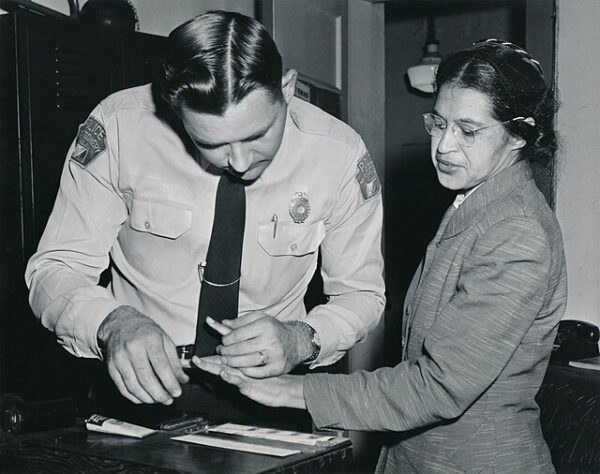
On the evening of December 1, 1955, in a humid Southern city still governed by the iron routines of Jim Crow, a single act of refusal cracked the façade of segregation. Rosa Louise McCauley Parks—42 years old, a department-store seamstress, and a quiet stalwart of the local NAACP—took her seat on a Montgomery bus and, when ordered to stand for a white passenger, did not move. The moment was small in scale yet immense in consequence. By nightfall, Montgomery’s machinery of racial order had been forced into motion; by morning, a movement would stand in its way.
Parks boarded the Cleveland Avenue bus after a long shift at Montgomery Fair. She sat in the first row of the “colored” section, a position legally permissible unless the white section filled. When additional white riders boarded, driver James F. Blake demanded that Parks and three other Black passengers surrender their seats. The others complied. Parks remained seated. She would later insist she was “not tired physically,” only “tired of giving in”—a phrase that neatly exposed the moral exhaustion carried by Black Montgomerians forced to perform deference as a civic duty.
Blake summoned police officers, who arrested Parks under the city’s segregation code, fingerprinted her, and placed her in custody before releasing her on bail. The ritual humiliation was familiar; the reaction it sparked was not. Within hours, news of the arrest coursed through Montgomery’s network of Black professionals, church leaders, and activists, where a quiet resolve began to harden. If the city wanted another demonstration of subordination, it would not get one.
Jo Ann Robinson of the Women’s Political Council had long awaited such a moment. She had warned city officials months earlier that a mass protest was coming if abuses continued. Working through the night of Parks’s arrest, Robinson and her colleagues produced thousands of leaflets calling for a one-day boycott of the city buses on Monday, the date of Parks’s trial. Churches became relay stations; pastors read the leaflets aloud from their pulpits, urging congregants to turn abstention into a civic weapon.
On December 5, Montgomery’s buses rolled down their routes nearly empty. Black riders—three-quarters of the system’s paying customers—walked miles to work, organized carpools, or relied on an improvised transportation network staffed by volunteers. In a single morning, a segregated transit system learned that its legal authority could not guarantee its economic survival.
That evening, more than 5,000 residents crowded into Holt Street Baptist Church. The atmosphere was electric: a mix of indignation, relief, and a dawning realization that something irreversible had begun. The assembly established the Montgomery Improvement Association to oversee the protest and chose as its leader a relatively unknown 26-year-old pastor from Dexter Avenue Baptist Church—Martin Luther King Jr. King’s rhetoric that night fused moral indictment with political clarity. “There comes a time,” he told the crowd, “when people get tired of being trampled over by the iron feet of oppression.” The line crystallized a shared sentiment: Montgomery’s Black citizens were finished accommodating a system designed to deny their humanity.

What followed was a year-long trial of endurance. The boycott lasted 381 days, surviving harassment, arrests, and economic pressure, as well as the bombing of King’s home. City officials sought to crush the movement by outlawing carpooling and threatening churches with prosecution. The participants did not bend. Their discipline—and the national attention it commanded—shifted the legal terrain. In November 1956, the Supreme Court upheld a federal ruling that declared Montgomery’s segregated buses unconstitutional. Three weeks later, Black and white riders boarded integrated buses for the first time.
Rosa Parks’s refusal was not an isolated spark but a deliberate assertion of personhood in a system built to negate it. The Montgomery Bus Boycott transformed her act into a collective declaration that the architecture of Jim Crow could be resisted—and, with persistence, dismantled. What began as a seat taken in quiet dignity became the opening chapter of a civil-rights revolution that would reorder the nation’s laws and test the meaning of its democratic promises.