
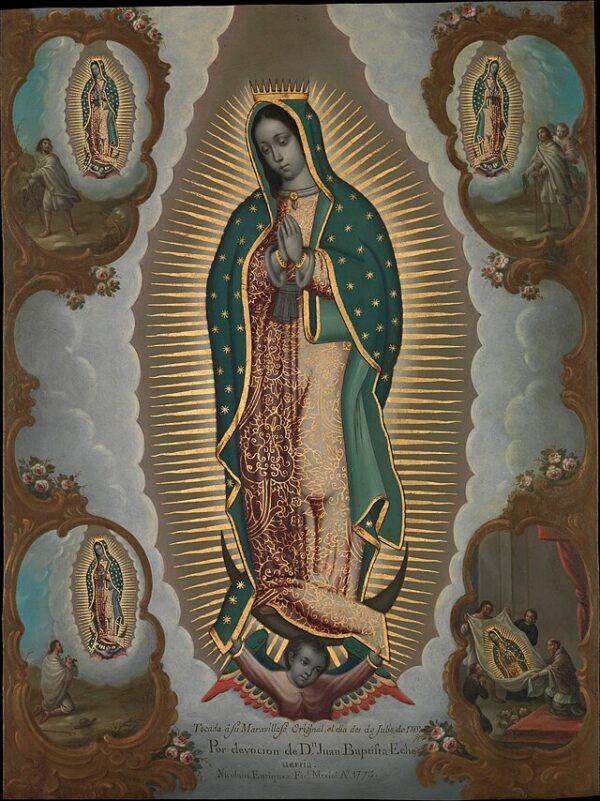
On the morning of December 9, 1531, a widowed Chichimeca-Nahua convert named Juan Diego set out across the northern outskirts of Mexico City toward the Franciscan mission at Tlatelolco to attend Mass. A relatively recent convert to Christianity, Juan Diego had been baptized only a few years earlier and had developed a reputation for humility, devotion, and a willingness to serve the local church. As he passed the hill of Tepeyac, he heard faint music and the sound of birds calling in a way that he later said felt unlike anything familiar in the region. Drawn toward the source of the sound, he climbed the hillside and soon reported seeing a radiant figure of a young woman who identified herself as the Virgin Mary, the Mother of God.
According to Juan Diego’s later testimony, the apparition appeared surrounded by light and spoke to him in Nahuatl, his native language. The Virgin requested that a church be built on the site of the apparition, explaining that she desired to show her love, compassion, and protection to all the people of the land. She asked Juan Diego to deliver the message to Bishop Juan de Zumárraga, the first bishop of Mexico, and insisted that she wished the chapel to serve as a refuge for prayer, consolation, and spiritual comfort.
Juan Diego obeyed immediately, walking several miles into the center of Mexico City to present her request to Bishop Zumárraga. The bishop, uncertain and aware of the extraordinary nature of the claim, did not dismiss him outright. Instead, he asked Juan Diego to return another day with more information or a sign that could confirm the authenticity of the apparition. Although discouraged, Juan Diego returned to Tepeyac later that same day to report the outcome. The Virgin appeared to him again and urged him to persist. She reassured him that with patience and faith, her message would be accepted, and the chapel would be built.
The next day, December 10, Juan Diego returned to speak with the bishop again. After listening to him attentively, Zumárraga asked with greater insistence for a convincing sign. Juan Diego relayed this request to the Virgin, and she promised to provide a proof that would satisfy the bishop. On December 12, the Virgin instructed Juan Diego to gather flowers from the summit of Tepeyac, a surprising directive given that December was not a season in which flowers naturally bloomed in the region. To Juan Diego’s astonishment, he found the hillside covered with Castilian roses—flowers native to Spain, not Mexico—growing fresh and abundant despite the winter conditions.
The Virgin arranged the flowers inside Juan Diego’s tilma, a rough cloak made of agave fiber. She instructed him not to open the garment until he reached the bishop. When Juan Diego arrived and released the tilma before Zumárraga, the roses spilled to the floor, and an image of the Virgin of Guadalupe—precisely as Juan Diego said she had appeared—was imprinted on the fabric. The bishop immediately fell to his knees in reverence, acknowledged the sign as miraculous, and ordered the construction of a chapel at Tepeyac.

Accounts from the period report that news of the apparition and the image spread rapidly throughout the region, becoming a powerful moment in the early history of Christianity in New Spain. Indigenous communities, previously slow to embrace the new religion, were struck by the meaning of a divine figure who spoke in their language, appeared in familiar dress and cultural form, and chose to reveal herself on a site long associated with sacred significance. The Basilica of Our Lady of Guadalupe now stands on the site of the apparition and remains one of the most important pilgrimage destinations in the Catholic world.