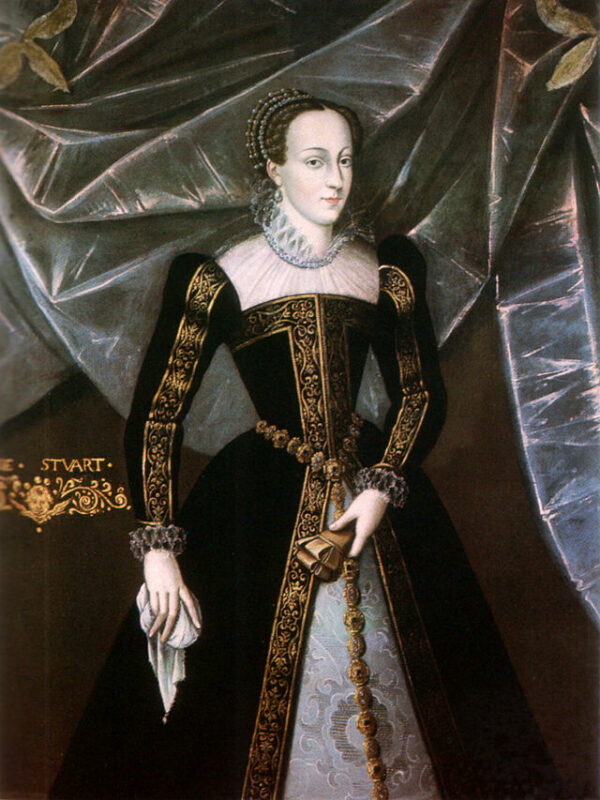
On December 14, 1542, the crown of Scotland passed to an infant scarcely a week old. Mary Stuart—known to history as Mary, Queen of Scots—became monarch upon the death of her father, James V, a king not yet 31, worn down by military defeat, illness, and despair. The moment marked not only one of the most extraordinary accessions in European history, but the beginning of a reign defined from the outset by fragility, faction, and the dangerous intersection of dynastic politics and religion.
James V died at Falkland Palace on December 14, six days after Mary’s birth at Linlithgow Palace. His death followed the disastrous Scottish defeat at the Battle of Solway Moss in November, where English forces routed a Scottish army and captured many nobles. According to later chroniclers, James took the loss as a personal humiliation. When news arrived that his queen, Mary of Guise, had given birth not to the hoped-for son but to a daughter, the king is said to have uttered the grim prophecy: “It came with a lass, and it will go with a lass”—a reference to the House of Stewart, which had itself come to power through a female line generations earlier. Whether apocryphal or not, the remark captured the mood of a reign ending in bitterness.
Mary’s accession immediately plunged Scotland into a prolonged regency. A one-week-old queen could not rule, and the question of who would govern in her name quickly became entangled with a larger struggle over Scotland’s future alignment. To the south stood Henry VIII of England, eager to secure the Scottish succession through marriage and thus unite the crowns. To the north and east lay France, Scotland’s traditional ally, bound by the Auld Alliance and increasingly important as religious divisions hardened across Europe.
At stake was not merely dynastic preference, but the survival of Scottish independence. Henry VIII moved swiftly, pressing for a marriage between the infant Mary and his son, Prince Edward. The resulting Treaty of Greenwich (1543) briefly promised such a union, but the Scottish Parliament soon repudiated it, suspicious of English intentions and wary of becoming a subordinate kingdom. What followed was the so-called “Rough Wooing”—a brutal English campaign of invasion, burning, and coercion designed to force compliance. Thus, before Mary could walk or speak, wars were already being fought in her name.
Religion compounded the instability. Scotland in 1542 remained officially Catholic, but Protestant ideas were spreading rapidly, influenced by continental reformers and English example. The regency government—first under James Hamilton, Earl of Arran, and later under Mary of Guise herself—had to balance noble factions divided not only by loyalty to England or France, but by faith. Mary’s very existence as queen became a symbol onto which these competing visions were projected: a Catholic monarch tied to France, or a Protestant-aligned ruler bound to England.
The solution ultimately chosen was exile. In 1548, at the age of five, Mary was sent to France for her safety and education, sealing her future as a French-raised queen. She would grow up at the glittering court of the Valois, marry the Dauphin (later Francis II), and absorb a political culture vastly different from the turbulent Scottish nobility she scarcely knew. Her removal from Scotland ensured immediate survival—but at the cost of deepening the distance between queen and kingdom.

Mary’s accession at one week old thus shaped the entirety of her life and reign. She never ruled Scotland as a child-queen in residence, never formed early bonds with her subjects, and never escaped the sense that her crown was less an inheritance than a burden imposed by history. The circumstances of 1542 ensured that her authority would always be contested, her legitimacy entangled in foreign alliances, and her personal fate inseparable from the larger religious and political convulsions of the 16th century.
December 14, 1542, then, was not merely the date a baby became queen. It was the opening chapter of one of the most tragic and consequential reigns in British history—a reign shaped, from its very first week, by forces far beyond the control of the child who wore the crown.