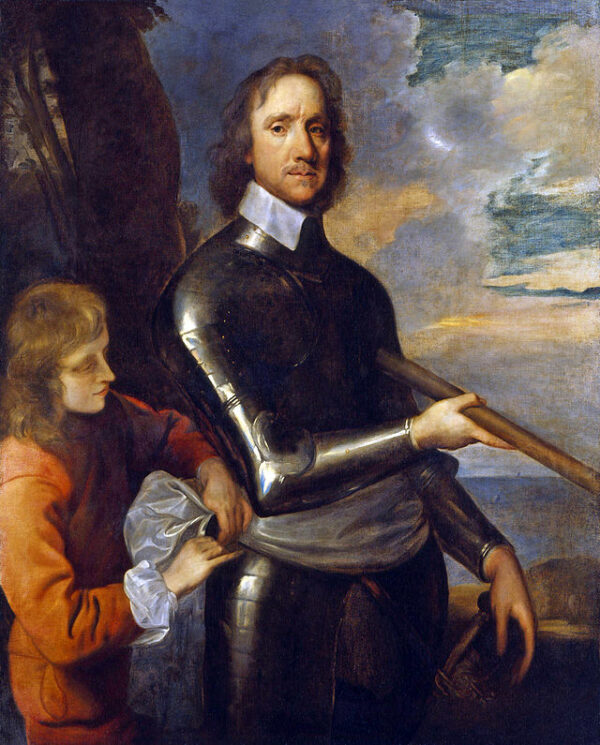
On December 16, 1653, Oliver Cromwell formally assumed the title of Lord Protector of the Commonwealth of England, Scotland, and Ireland, marking the beginning of the English Protectorate and one of the most paradoxical chapters in British constitutional history. Less than four years after the execution of King Charles I, England found itself governed not by a monarch, but by a soldier-statesman wielding powers that in many respects rivaled those of the crown he had helped destroy.
Cromwell’s elevation was the product of exhaustion as much as ideology. The English Civil Wars had shattered the old political order, but the republican experiment that followed proved unstable. After the monarchy was abolished in 1649, England was ruled by the Rump Parliament, a remnant of the Long Parliament purged of royalists and moderates. It governed hesitantly, failed to enact sweeping reforms, and appeared increasingly self-interested. In April 1653, Cromwell forcibly dissolved it, declaring that it had sat too long “for any good you have been doing.”
The alternative, the short-lived Nominated Assembly—often derisively called Barebone’s Parliament—collapsed under the weight of its own divisions by December. Faced with political paralysis, army leaders turned to a written constitution, the Instrument of Government, England’s first and only codified constitution. It created the office of Lord Protector, to be held for life, alongside a Council of State and a single-chamber Parliament. Cromwell accepted the role on December 16, swearing an oath not to rule arbitrarily and to uphold the laws of the land.
In theory, the Protectorate was a balanced republican system. In practice, it rested heavily on Cromwell’s authority and the loyalty of the New Model Army. The Lord Protector held control over the armed forces, significant influence over legislation, and the power to summon and dissolve Parliament. Though the constitution explicitly rejected kingship, the ceremonial trappings of Cromwell’s rule—his residence at Whitehall, his guard of honor, and his quasi-royal court—made the distinction appear increasingly thin.
Cromwell himself was acutely aware of the contradiction. A deeply religious man, he believed his authority derived from divine providence rather than heredity. He repeatedly rejected calls to take the crown, insisting that monarchy was incompatible with the principles for which the civil wars had been fought. Yet he also believed that England required firm, godly rule to prevent chaos, Catholic resurgence, or the return of the Stuart dynasty.
The Protectorate sought to stabilize a fractured realm. England remained economically strained, politically polarized, and religiously volatile. Cromwell promoted limited religious toleration for Protestant dissenters—Independents, Baptists, and Quakers—while maintaining restrictions on Catholics and Anglicans associated with royalism. His regime also pursued moral reform, encouraging Sabbath observance and suppressing activities deemed licentious, such as bear-baiting and some forms of theater.
Abroad, Cromwell projected English power aggressively. The Commonwealth navy challenged Dutch commercial dominance, and England emerged as a major Protestant force in European diplomacy. In Ireland and Scotland, however, Cromwell’s legacy was darker. His brutal campaigns—particularly the 1649 sieges of Drogheda and Wexford—left lasting scars and entrenched hostility that would echo for centuries.

Despite its constitutional aspirations, the Protectorate struggled to function smoothly. Parliaments resisted Cromwell’s authority, questioned army dominance, and clashed over taxation and reform. By 1657, Parliament even offered Cromwell the crown under the Humble Petition and Advice, an attempt to stabilize governance through a restored monarchy in all but name. Cromwell again refused, though he accepted expanded powers and a more formal court.
When Cromwell died in 1658, the Protectorate quickly unraveled. His son Richard lacked his authority and military backing. Within two years, the monarchy was restored under Charles II, ending the Interregnum and consigning the Protectorate to a brief, contested place in English history.