On December 20, 1803, in a modest ceremony in New Orleans, American officials formally took possession of the Louisiana Territory, completing what would become one of the most consequential land transfers in world history: the Louisiana Purchase. With that act, the United States doubled its size, secured control of the Mississippi River, and set itself irreversibly on the path to continental power.
The transfer marked the end of a complex geopolitical drama that had unfolded over several years. Originally claimed by France, Louisiana had been transferred to Spain in 1762 after the Seven Years’ War. For decades, Spanish rule kept the vast territory largely undeveloped but strategically valuable, particularly for its control of New Orleans, the critical port through which much of America’s agricultural commerce flowed. In 1800, however, Spain quietly returned Louisiana to France under the Treaty of San Ildefonso, raising alarm in the young American republic.
President Thomas Jefferson understood the danger immediately. A resurgent France under Napoleon Bonaparte, controlling New Orleans, posed a direct threat to American trade and security. Jefferson feared that French dominance at the mouth of the Mississippi could strangle western settlement or force the United States into unwanted alliances. Although deeply committed to a strict interpretation of the Constitution, Jefferson authorized envoys James Monroe and Robert Livingston to negotiate the purchase of New Orleans—and perhaps some surrounding land—if the opportunity arose.
Events in Europe and the Caribbean soon transformed that limited mission into something far grander. France’s efforts to rebuild its New World empire collapsed after a slave revolt in Saint-Domingue (modern Haiti) devastated French forces and yellow fever decimated Napoleon’s army. Facing renewed war with Britain and in need of cash, Napoleon abandoned his American ambitions. In 1803, French officials stunned the American negotiators by offering to sell all of Louisiana—more than 800,000 square miles—for $15 million.
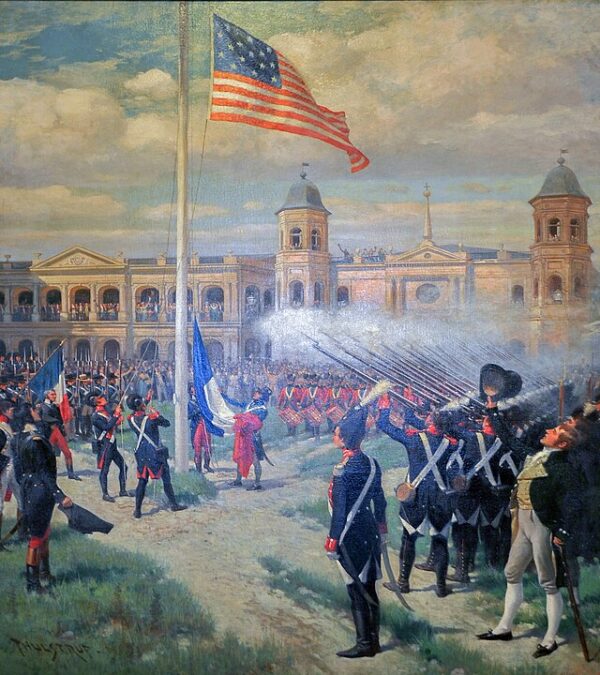
The agreement, finalized in Paris in April 1803, still required formal transfer on American soil. That moment came on December 20 in New Orleans, where French Prefect Pierre Clément de Laussat lowered the tricolor flag and raised the American flag over the city. The ceremony was restrained and orderly, but its implications were revolutionary. Overnight, the United States gained control of territory stretching from the Mississippi River to the Rocky Mountains, and from the Gulf of Mexico to present-day Canada.
The purchase reshaped the nation’s future in ways few at the time could fully grasp. It guaranteed American access to the Mississippi River, fueling agricultural expansion and commerce. It accelerated westward migration, opening vast lands to farmers, traders, and settlers. It also intensified unresolved conflicts—particularly over the extension of slavery into new territories—conflicts that would eventually culminate in the Civil War.

The Louisiana Purchase also tested constitutional boundaries. Jefferson privately worried that the Constitution did not explicitly authorize the acquisition of foreign territory. He briefly considered seeking a constitutional amendment but ultimately concluded that the treaty-making power was sufficient. The Senate ratified the treaty in October 1803, setting a powerful precedent for executive authority in foreign affairs.
By the time the flags changed in New Orleans that December day, the United States had quietly completed one of the most audacious diplomatic bargains in history. For a relatively modest sum, it secured land, resources, and strategic depth that would define the nation’s destiny.