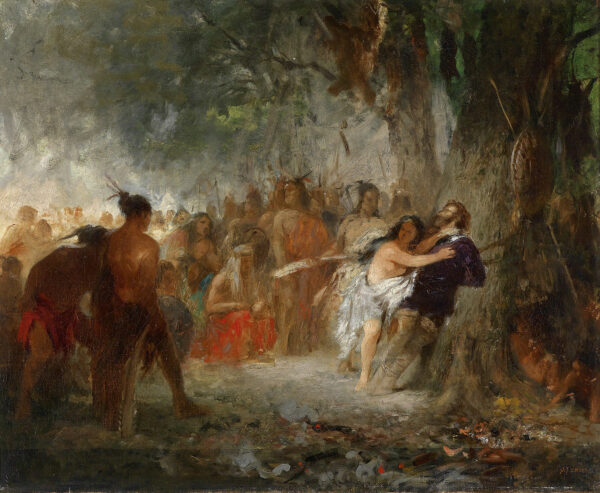
In 1607, during the precarious first year of England’s Jamestown experiment in North America, Captain John Smith later claimed that his life was spared through the intervention of Pocahontas, the young daughter of the powerful Algonquian leader Wahunsenacawh. According to Smith’s account, the dramatic encounter took place in December—traditionally dated to December 29—after he was captured by warriors of the Powhatan Confederacy, a loose alliance of tribes dominating the Tidewater region of present-day Virginia.
Smith had been exploring the Chickahominy River in search of food and information when he was seized and brought before Wahunsenacawh, whom the English called “Powhatan.” Over several weeks, Smith wrote, he was displayed among various villages before being brought to the paramount chief’s main settlement. There, Smith claimed, tribal leaders prepared to execute him by beating his head with clubs. At the moment of impending death, Pocahontas—described by Smith as a young girl, likely around ten or eleven—rushed forward, laid her head upon his, and pleaded for his life. Wahunsenacawh relented, sparing Smith and eventually returning him to Jamestown.
This episode, first fully recorded by Smith in his 1624 work The Generall Historie of Virginia, has become one of the most famous—and contested—stories in early American history. Smith’s earlier writings, including A True Relation (1608), recount his capture but omit any mention of Pocahontas intervening to save him. The absence of the story in these earlier accounts has led many historians to question its literal truth, suggesting that Smith may have embellished the tale later in life to enhance his reputation or to craft a compelling narrative for English readers.
Modern scholarship, however, has not dismissed the event outright. Some historians argue that Smith may have misunderstood a ritual of symbolic execution and adoption common among Algonquian peoples. In this interpretation, the staged “execution” represented a ceremonial death, followed by rebirth into a new social relationship with the Powhatan leadership. Pocahontas’s role, then, may have been ritual rather than spontaneous—a formal act signaling Smith’s incorporation as a subordinate ally or intermediary rather than his physical rescue from death.
Whatever the precise nature of the event, its significance lies in what it reveals about early encounters between English colonists and Native peoples. Jamestown in 1607 was weak, under-supplied, and dependent on Powhatan goodwill for survival. Wahunsenacawh presided over a sophisticated political system and initially viewed the English as potential trading partners—or manageable intruders—rather than equals. Smith’s release, whether dramatic or ceremonial, reflected Powhatan strategy as much as personal mercy.

Pocahontas herself would later play a documented diplomatic role, acting as a go-between during periods of fragile peace and helping facilitate the exchange of food for goods. Her later capture by the English, conversion to Christianity, marriage to John Rolfe, and death in England in 1617 demonstrate how she became committed to the world that was changing around her.