

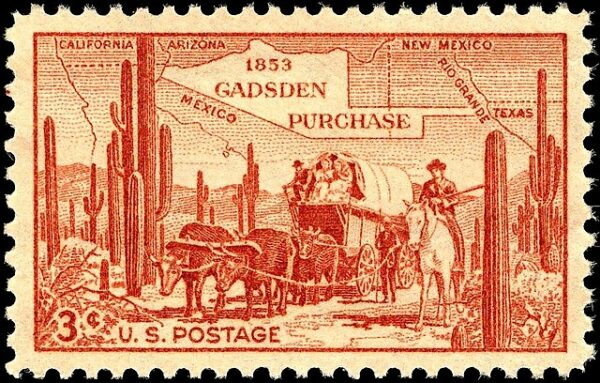
On December 30, 1853, the United States finalized the Gadsden Purchase, a land deal with Mexico that reshaped the map of the Southwest and reflected the era’s fixation on expansion, commerce, and continental infrastructure. For $10 million, the U.S. acquired roughly 29,670 square miles of territory—parts of what are now southern Arizona and New Mexico—with one overriding goal: to secure a feasible southern route for a transcontinental railroad.
The purchase was negotiated by James Gadsden, a former railroad executive and U.S. minister to Mexico, acting under instructions from President Franklin Pierce. American engineers had discovered that the border drawn by the 1848 Treaty of Guadalupe Hidalgo—ending the Mexican-American War—left the most practical southern rail corridor south of the U.S. line. Mountain ranges and desert terrain north of the border complicated construction, threatening the dream of an all-weather rail connection between the Mississippi Valley and the Pacific.
For Mexico, the agreement came at a moment of profound weakness. President Antonio López de Santa Anna faced political instability, debt, and lingering damage from the war with the United States. The sale provided immediate cash to a government desperate for revenue, though it further fueled domestic resentment over lost territory. Many Mexicans viewed the transaction as another humiliation imposed by a powerful neighbor, deepening distrust that would echo for generations.
In Washington, the Gadsden Purchase was the last major territorial acquisition of the continental United States, but it was hardly uncontroversial. Northern lawmakers suspected the southern railroad route would strengthen slaveholding interests and expand the political power of the South. The debate over the purchase therefore intersected with the era’s intensifying sectional conflict, foreshadowing the battles that would erupt during the American Civil War.
Though the railroad envisioned in 1853 was not immediately built, the land proved strategically vital. Decades later, it became the path for the Southern Pacific Railroad, linking Texas to California and accelerating settlement, trade, and military movement across the region. The purchase also fixed the modern U.S.–Mexico border in the Southwest, a boundary that remains politically and culturally significant today.

The Gadsden Purchase was, at its core, a transaction driven by steel rails and economic ambition. Yet its consequences extended far beyond transportation, shaping geopolitics, regional development, and the enduring complexities of the American Southwest.