On January 5, 1914, in a move that stunned American industry and rewrote the rules of factory labor, the Ford Motor Company announced that it would more than double the daily pay of its workers while shortening the workday. Beginning January 12, eligible employees would earn a minimum of $5 a day for an eight-hour shift, replacing the prevailing nine-hour day that paid roughly $2.34.
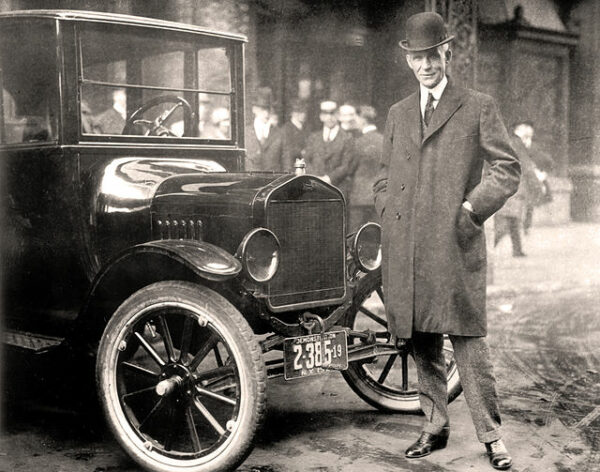
The policy, unveiled by company founder Henry Ford and vice president James Couzens, was framed not as generosity but as “profit-sharing” and what Ford called efficiency engineering. The announcement ricocheted across the country. Within hours, thousands of job seekers flooded the gates of Ford’s Highland Park Plant, lining up in bitter winter weather for a chance at what instantly became the best factory job in America.
The decision came amid a brutal industrial reality. Early-20th-century factory labor was defined by long hours, low pay, and dangerous conditions. Ford himself had helped intensify the strain. In 1913, the company introduced the moving assembly line, a technological breakthrough that slashed the time required to assemble a Model T chassis from more than 12 hours to about 93 minutes. Production soared, but the work became monotonous and exhausting, with employees repeating the same task hundreds of times a day.
The human cost soon became impossible to ignore. By late 1913, Ford’s annual employee turnover rate had exploded to well over 300 percent, commonly cited at 370–380 percent. To keep 100 workers on the line, the company often had to hire nearly 1,000. Training costs ballooned, productivity suffered, and the stability of the assembly line itself was threatened—especially during the 1913–1914 economic downturn and amid growing fears of labor unrest and radical union organizing.
Ford’s motives were bluntly pragmatic. He needed workers who would stay, perform at peak efficiency, and tolerate the discipline of mechanized production. Higher wages promised lower turnover and higher output. The shorter workday allowed the plant to operate on three shifts, keeping machines running nearly around the clock. There was also a secondary effect Ford openly acknowledged: well-paid workers could afford the Model Ts they built, expanding the market for his cars and accelerating the rise of a consumer economy.
The $5 day, however, was not a universal raise. Base wages remained closer to $2.34–$2.50, with the remainder paid as a profit-sharing bonus. Eligibility was contingent on strict behavioral standards enforced by Ford’s controversial Sociological Department, whose investigators conducted unannounced home visits. Workers were evaluated for sobriety, thrift, family stability, and moral conduct. Many women, younger unmarried men, and some immigrant workers were initially excluded. While Ford would later employ large numbers of Black workers—often at higher wages than competitors—the system was widely criticized as intrusive and paternalistic.
The immediate impact was electric. The day after the announcement, an estimated 10,000 job seekers descended on Highland Park, overwhelming security and forcing police to intervene with fire hoses to control the crowd. Inside the plant, turnover collapsed, productivity surged, and output climbed rapidly. Ford produced more than 300,000 vehicles in 1914, capturing roughly half of the U.S. automobile market. Profits followed, roughly doubling between 1914 and 1916, while Model T sales surpassed 500,000 units by 1915.
Competitors bristled. The Wall Street Journal derided Ford for injecting “spiritual principles” into business. Yet rival manufacturers soon raised wages to compete, setting off a broader transformation in industrial pay standards. The eight-hour day gained momentum nationwide, reshaping expectations about work and leisure.

Adjusted for inflation, Ford’s $5 daily wage equates to roughly $150–$160 today, or about $18–$20 an hour—far above prevailing factory wages of the era. The experiment demonstrated that paying workers more could increase profits through stability, productivity, and consumption, a lesson that would later underpin modern efficiency-wage theory.
The system was not permanent. Ford dismantled the Sociological Department by 1921, and the company’s aggressive anti-union stance delayed formal unionization until the 1940s. Even so, the significance of January 5, 1914, endures. With a single announcement, Henry Ford did more than raise wages—he accelerated a fundamental shift in American labor, proving that industrial dominance could be built not only on machines, but on investing in the people who ran them.