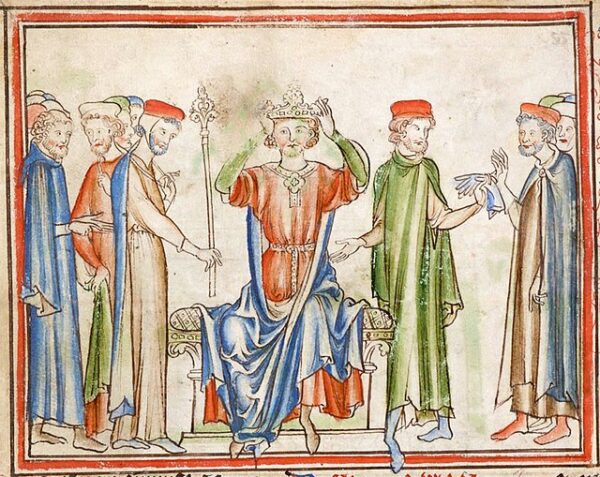
On January 6, 1066, England made a choice meant to preserve order—and in doing so set itself on the path to conquest. The day after the death of Edward the Confessor, the kingdom’s leading nobles and churchmen gathered in London for an emergency session of the Witan. The matter before them was urgent and unforgiving: England needed a king, and it needed one immediately. By the end of the day, the council confirmed Harold Godwinson as ruler—and crowned him the same day.
The speed of the decision was no accident. Edward had died childless, leaving behind a realm outwardly stable but politically brittle. For years, the question of succession had lingered unresolved, complicated by competing dynastic claims, foreign interests, and Edward’s own ambiguous gestures. Delay, the Witan understood, would invite disorder—or worse, invasion. A crowned king, even one whose claim might be contested, was better than a vacant throne.
Harold Godwinson was the practical choice. As Earl of Wessex, he dominated the political and military landscape of England, commanding the richest territory and the loyalty of experienced warriors. He had served as Edward’s chief adviser and military enforcer, suppressing rebellions and defending the realm’s borders. Crucially, Harold was present in England when Edward died. His rivals were not. In an age where speed mattered as much as pedigree, proximity carried decisive weight.
English sources later maintained that Edward named Harold his successor on his deathbed, entrusting him with the kingdom in its final hours. Norman accounts, unsurprisingly, disputed this claim. Whether Edward made such a designation—or whether it was later shaped to legitimize Harold’s rule—remains contested by historians. What mattered on January 6 was not certainty, but consent. The Witan, acting within long-standing custom, gave it.
Anglo-Saxon kingship was not strictly hereditary. While royal blood mattered, legitimacy flowed from recognition by the kingdom’s leading men. The Witan had deposed kings before; it had also elevated men who could defend the realm. Harold fit that tradition precisely. His coronation at Westminster—likely conducted by Archbishop Ealdred of York—was a public assertion that England remained governed by its own political order, not by foreign promise or inherited claim.
That assertion was immediately challenged. Across the Channel, William of Normandy regarded Harold’s coronation as a provocation. William claimed that Edward had promised him the English throne years earlier and that Harold himself had sworn an oath in Normandy to uphold that promise. To William, Harold was not a legitimate king but a perjurer and usurper. In Scandinavia, King Harald Hardrada advanced a separate claim rooted in earlier dynastic agreements, preparing his own invasion. England now faced threats from both north and south.
In that sense, Harold’s same-day coronation solved one problem while clarifying another. Domestically, it ensured continuity and authority. Internationally, it hardened rival claims into casus belli. By accepting the crown, Harold made war all but inevitable. The crown he wore on January 6 was less a symbol of peace than a declaration of defiance.

The year that followed unfolded with ruthless speed. In September, Hardrada invaded England and was met by Harold at Stamford Bridge. The English victory was decisive—and devastating. Harold’s army prevailed, but at enormous cost. Within days, William landed on the southern coast. Harold force-marched his exhausted forces south to meet the new threat. On October 14, 1066, Harold was killed at the Battle of Hastings, and with him ended nearly six centuries of Anglo-Saxon rule.
By Christmas, William was crowned king, inaugurating the Norman Conquest and transforming England’s political, linguistic, and social order. French-speaking elites replaced the old nobility. Norman castles reshaped the landscape. English law, culture, and identity were permanently altered.