

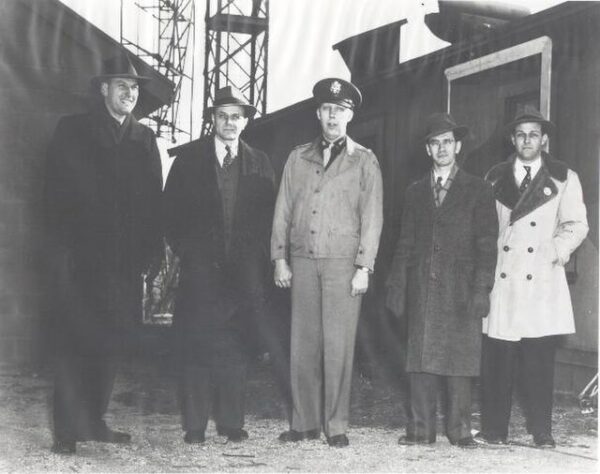
On January 10, 1946, in the austere aftermath of World War II, a small team of American scientists quietly achieved something that, in retrospect, marked the opening salvo of the Space Age. At Camp Evans, a former radar laboratory in New Jersey, the United States Army Signal Corps successfully conducted Project Diana, transmitting radio waves toward the Moon and receiving the faint echoes that bounced back to Earth. Humanity had, for the first time, made deliberate contact with another celestial body using its own technology.
The experiment itself was deceptively simple in concept but formidable in execution. Radar—refined and weaponized during the war—had proven capable of detecting aircraft and ships across vast distances. The question confronting postwar scientists was whether those same radio waves could traverse the far greater gulf between Earth and the Moon, roughly 238,000 miles away, and still return with a detectable signal. Many doubted it was possible. The Moon was not a metallic bomber wing or a ship’s hull; it was an irregular, rocky surface that might scatter radio energy into useless noise.
The team, led by physicist John H. DeWitt Jr., repurposed surplus wartime equipment to find out. Using a modified SCR-271 radar system operating at approximately 111.5 megahertz, they aimed a large fixed antenna at the rising Moon in the pre-dawn hours of January 10. Timing was everything. The antenna could not track the Moon continuously, so the researchers waited for the precise moment when Earth’s rotation would bring the lunar surface into alignment with their beam.
When the radar pulses were transmitted, the scientists waited—about 2.5 seconds, the time required for a radio signal to travel to the Moon and back. Then, on an oscilloscope, a faint but unmistakable blip appeared. The signal had returned. The Moon had answered.
The immediate significance of Project Diana was practical as much as symbolic. During the war, military planners worried that the Earth’s ionosphere—an electrically charged layer of the upper atmosphere—might block or unpredictably distort long-distance radio communications, especially at higher frequencies. By successfully bouncing signals off the Moon, the Signal Corps demonstrated that radio waves could pass cleanly through the ionosphere into space and back again. This confirmation laid critical groundwork for postwar advances in radar, telecommunications, and eventually satellite communications.
Yet the broader implications reached far beyond military engineering. Project Diana marked the first instance of active space communication—not merely observing the heavens, but interacting with them. Unlike astronomy, which passively collects light from distant objects, this experiment involved sending a human-made signal beyond Earth and receiving its return. It was a conceptual shift as profound as it was technical: space was no longer unreachable, unknowable, or silent.
In the years that followed, the principles proven at Camp Evans would underpin an entire technological ecosystem. Lunar radar experiments evolved into deep-space tracking systems. The ability to send and receive signals beyond Earth became essential to the satellite age of the 1950s and 1960s, from early communications satellites to interplanetary probes. When Apollo astronauts later spoke to Mission Control from the lunar surface, their voices traveled along pathways first validated by Project Diana.

There was also a psychological dimension to the achievement. In 1946, the world was grappling with the destructive power of modern science, freshly scarred by atomic warfare. Project Diana offered a different vision of technological prowess—one oriented toward exploration rather than annihilation. The Moon, long a symbol of mystery and distance in human culture, had been touched not by rockets or footprints, but by invisible waves of human intention.
Quietly, without fanfare, the experiment on January 10 demonstrated that Earth was no longer a closed system. Signals could leave the planet, traverse the void, and return. In that moment, standing amid surplus radar equipment and flickering screens, the scientists of Project Diana did more than confirm a theory. They proved that humanity had acquired the means to reach outward.