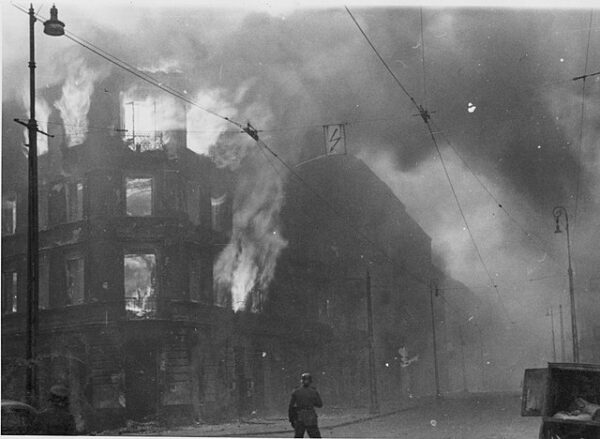
On January 18, 1943, armed Jewish resistance erupted inside the Warsaw Ghetto, marking the first organized uprising by Jews against Nazi Germany during the Holocaust. Though smaller and less well-known than the April revolt that would follow, the January uprising fundamentally altered the moral and political meaning of Jewish resistance under Nazi rule. It shattered the illusion of passive compliance and demonstrated that even under conditions of starvation, terror, and near-certain death, organized defiance was possible.
By early 1943, the Warsaw Ghetto had already been devastated. Created in 1940 as the largest Jewish ghetto in Nazi-occupied Europe, it initially confined more than 400,000 Jews into a sealed district of extreme overcrowding, disease, and hunger. Beginning in July 1942, the Nazis launched the Grossaktion Warsaw, deporting approximately 300,000 Jews to the Treblinka extermination camp in just eight weeks. Those transports were framed as “resettlement,” but by the autumn, the truth had become undeniable: deportation meant death.
The survivors—roughly 60,000 Jews remaining in the ghetto—understood that annihilation was imminent. Out of this realization emerged armed resistance groups, most notably the Jewish Combat Organization (ŻOB) and the Jewish Military Union (ŻZW). These groups were young, poorly armed, and politically divided, but they shared a common conclusion: survival was unlikely, but dignity could still be asserted through resistance.
When German forces entered the ghetto on January 18, 1943, to resume deportations, they encountered something unexpected. Instead of docile crowds assembling at collection points, armed fighters melted into the streets. Small units ambushed German patrols, fired pistols and grenades, and disrupted the roundups. Civilians fled into prepared bunkers and hiding places, many of them newly constructed beneath buildings and rubble. For the first time, deportation was not routine.
The fighting lasted only four days, but its psychological impact was immense. German forces withdrew, having deported far fewer Jews than planned. The withdrawal was not a military defeat for the Nazis—but it was a strategic shock. The assumption that the ghetto could be emptied without resistance had been proven false. For Jewish fighters, the meaning was even clearer: armed resistance could delay deportation and reclaim a measure of agency over fate.
One of the central figures in organizing the resistance was Mordechai Anielewicz, a 23-year-old Zionist youth leader who would later command the April uprising. Writing after January, Anielewicz described a transformation in morale. Fear had not vanished, but resignation had. The ghetto was no longer simply awaiting destruction; it was preparing for battle.
Importantly, the January uprising also exposed the limits of resistance. Weapons were scarce—mostly pistols, homemade bombs, and a few rifles. External support from the Polish underground was inconsistent and insufficient. Starvation and disease continued unabated. Yet these constraints did not negate the meaning of the act. Resistance was not measured in territory held or enemies killed, but in the refusal to be reduced to helpless victims.

In the weeks following January 18, the ghetto became a fortified underground city. Bunkers were expanded, escape routes mapped, and fighters trained. The Nazis, for their part, began planning a decisive operation to liquidate the ghetto entirely. That confrontation would come on April 19, 1943, the eve of Passover, when German forces returned in overwhelming strength and ignited the full Warsaw Ghetto Uprising.
But January 18 remains the turning point. It was the moment when Jews in the Warsaw Ghetto crossed the threshold from endurance to defiance. They chose, deliberately and collectively, to fight on their feet than kneel to their murderers.