
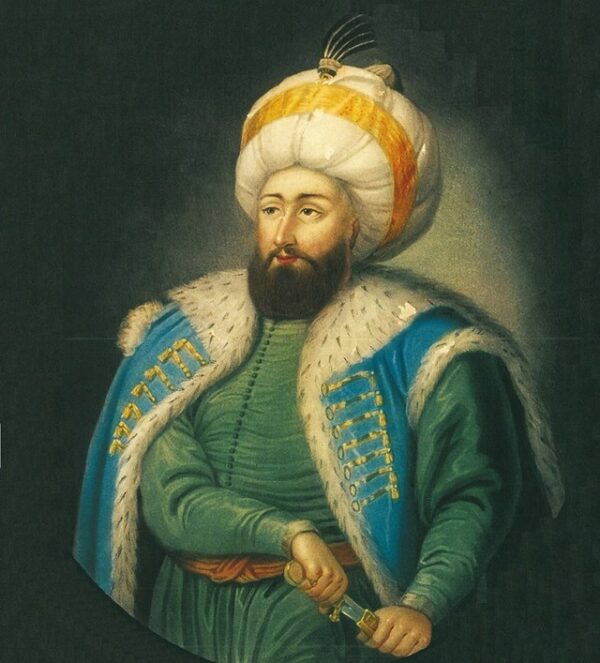
On February 3, 1451, Mehmed II ascended the throne of the Ottoman Empire, inheriting a state that was powerful, ambitious, and unfinished. At just nineteen years old, Mehmed succeeded his father, Murad II, whose reign had stabilized Ottoman rule in Anatolia and the Balkans but had stopped short of achieving the empire’s most coveted prize: Constantinople. Mehmed’s accession marked not merely a generational transition, but the opening of a transformative chapter in world history.
Mehmed was no inexperienced prince unexpectedly thrust into power. He had briefly ruled once before, from 1444 to 1446, when Murad II abdicated in favor of his teenage son. That early experiment in kingship proved turbulent. European powers, sensing weakness, launched a renewed crusading effort that culminated in the Battle of Varna, forcing Murad back onto the throne. The episode left a lasting imprint on Mehmed. It sharpened his distrust of Christian powers, deepened his sense of destiny, and convinced him that true authority required both military supremacy and administrative control.
When Murad II died in early 1451, the Ottoman Empire Mehmed inherited was formidable but strategically constrained. Ottoman territory encircled Constantinople on both its European and Asian sides, yet the ancient city—capital of the Byzantine Empire—remained a stubborn outpost, symbolically powerful and geopolitically disruptive. As long as Constantinople stood outside Ottoman control, the empire’s cohesion and prestige were incomplete. For Mehmed, this was not merely a strategic inconvenience but an ideological challenge.
Almost immediately upon ascending the throne, Mehmed moved decisively to consolidate power. He neutralized potential rivals within the dynasty, reaffirmed loyalty among the Janissaries, and signaled continuity to provincial governors. Yet beneath this surface stability lay a radical ambition. Mehmed envisioned himself not only as an Ottoman sultan but as a universal ruler—a successor to Roman emperors and Islamic caliphs alike. His court culture, education, and patronage reflected this synthesis. Fluent in several languages and deeply interested in history, philosophy, and engineering, Mehmed was a ruler who combined intellectual curiosity with ruthless pragmatism.
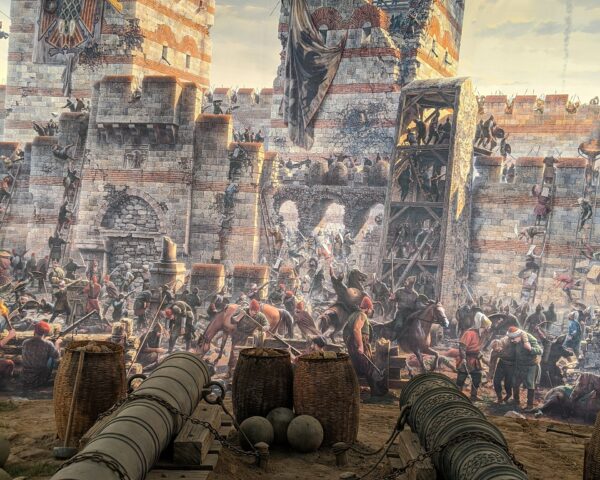
The young sultan’s preparations for war began almost immediately. He ordered the construction of the massive fortress Rumeli Hisarı along the Bosphorus, effectively cutting Constantinople off from Black Sea supply routes. He recruited foreign engineers, including experts in cannon casting, and invested heavily in artillery technology that would soon render the city’s ancient walls obsolete. These efforts underscored a defining feature of Mehmed’s rule: his willingness to adapt and innovate in pursuit of imperial goals.

While European courts initially underestimated Mehmed—mistaking youth for weakness—the sultan carefully masked his intentions through diplomacy. Treaties were renewed, reassurances offered, and distractions encouraged elsewhere. But by 1452, the direction of Ottoman policy was unmistakable. Constantinople’s fate was sealed.
Mehmed’s accession in 1451 stood as the beginning of one of history’s most consequential conquests. When Constantinople fell in May 1453, Mehmed would earn the title Fatih—“the Conqueror”—and transform the city into Istanbul, the new imperial capital of a rapidly expanding empire. The event would mark the end of the Byzantine Empire, reshape global trade routes, accelerate the transmission of classical knowledge to Western Europe, and symbolically close the medieval era.