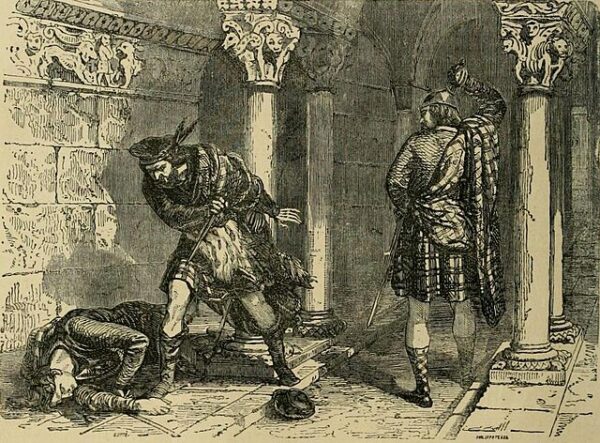
On February 10, 1306, a killing inside a church in the Scottish border town of Dumfries turned a long, faltering resistance into an open revolution. Before the high altar of Greyfriars Church, Robert the Bruce struck down his political rival John Comyn. In medieval Europe, where churches were treated as sanctuaries and altars as inviolable, the act was shocking. In the context of Scotland’s struggle against English domination, it was decisive.
The murder did not simply remove a rival claimant to the throne. It eliminated any remaining path of compromise. From that moment on, Bruce could no longer maneuver between submission and resistance. The Wars of Scottish Independence, already simmering, entered their final and most consequential phase.
By 1306, Scotland had endured nearly a decade of English control. Edward I of England had used a disputed succession to assert himself as overlord, forcing Scottish nobles to swear loyalty and removing King John Balliol from the throne. Early resistance, most famously led by William Wallace, had ended in defeat. Wallace’s execution in 1305 appeared to confirm English supremacy. Scotland’s political class was fractured, demoralized, and divided over what came next.
Bruce and Comyn stood at the center of that division. Both descended from royal bloodlines. Both possessed credible claims to the Scottish crown. Yet they represented opposing strategies. Bruce had wavered, alternately submitting to Edward I and quietly positioning himself as a potential leader of resistance. Comyn, head of one of the most powerful families in Scotland and a relative of the deposed Balliol, had aligned more consistently with the English, calculating that accommodation offered the best chance to preserve his family’s influence.
The meeting at Greyfriars Church was meant to resolve that rivalry. Contemporary accounts differ on who said what, but they agree on the result. An argument broke out. Bruce stabbed Comyn inside the church. When word reached Bruce that Comyn might still be alive, one of his companions reportedly returned to finish the killing. The location ensured the act would resonate far beyond Dumfries. Murder was grave enough; murder at the altar was sacrilege.
The response was swift. Bruce was excommunicated. The Church condemned the act. Edward I now had clear justification to treat Bruce as a traitor rather than a wavering noble. But the very severity of the consequences forced Bruce forward. With retreat impossible, he moved quickly to claim the crown.
Just six weeks later, on March 25, 1306, Bruce was crowned King of Scots at Scone. The ceremony was improvised and incomplete, lacking key regalia seized by the English, but the symbolism was unmistakable. Bruce had declared open defiance of English authority.
The declaration nearly destroyed him. English forces defeated Bruce repeatedly in the months that followed. His family was captured; several of his supporters were executed. Bruce himself was driven into hiding, reduced to a fugitive waging small-scale attacks while avoiding capture. For a time, his cause appeared doomed.

Yet it was precisely the irrevocable nature of his actions at Dumfries that sustained the rebellion. Bruce had no alternative future to bargain for. Over the next several years, he adapted. He abandoned conventional battles in favor of ambushes and rapid movement. He ordered castles destroyed rather than occupied, denying the English permanent footholds. Gradually, the tide turned.
By 1314, Bruce was strong enough to confront England directly. At Bannockburn, his forces defeated Edward II’s army in a battle that reshaped the conflict. The victory did not end the war, but it made Scottish independence a practical reality. Fourteen years after the killing at Greyfriars, England formally recognized Scotland as a sovereign kingdom, with Bruce as its king.