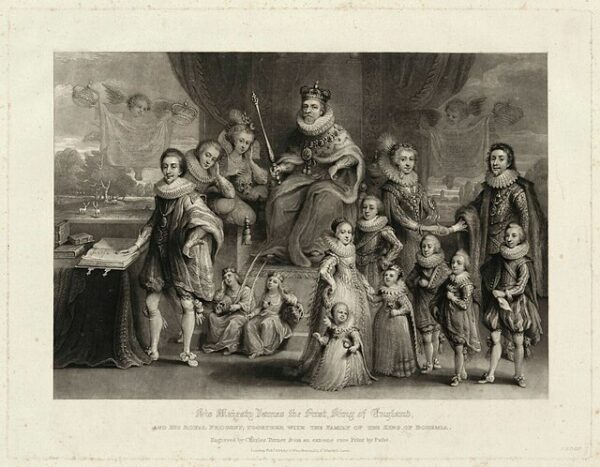
On February 22, 1371, the Scottish crown passed quietly—but decisively—into new hands. With the death of David II, son of Robert the Bruce, the direct Bruce line came to an end. Ascending in his place was his nephew, Robert II of Scotland, the first monarch of the House of Stewart, inaugurating a royal dynasty that would shape not only Scotland, but eventually England and Ireland as well.
Robert’s path to the throne had been long and politically intricate. Born in 1316, he was the son of Walter Stewart, the 6th High Steward of Scotland, and Marjorie Bruce, daughter of Robert the Bruce. Through his mother, he carried the bloodline of Scotland’s most celebrated warrior-king. The Stewart family—later spelled Stuart—had risen steadily in influence during the Wars of Scottish Independence. The office of High Steward, originally an administrative post within the royal household, had by the 14th century become one of the most powerful positions in the realm.
When Robert the Bruce secured Scottish independence after years of struggle against England, the question of succession lingered uneasily. His only surviving legitimate son, David II, inherited the throne in 1329 as a child. David’s reign proved turbulent. Captured by the English at the Battle of Neville’s Cross in 1346, he spent eleven years in captivity. During that period, Robert Stewart served as guardian of the kingdom—twice, in fact—developing a reputation as a cautious, pragmatic political operator.
David II returned to Scotland in 1357 but failed to produce an heir. Relations between uncle and nephew were strained. At times David explored schemes that would have altered the succession in favor of English claimants, alarming the Scottish nobility. Yet by the established line of inheritance, Robert Stewart remained the legitimate successor.
When David II died unexpectedly at Edinburgh Castle in February 1371, the transition was relatively smooth. On February 22, Robert was crowned at Scone. He was 55 years old—an advanced age by medieval standards—and became the first Stewart king of Scotland.
The significance of that moment extended beyond the ceremony itself. With Robert II’s coronation, the Stewart dynasty formally began. Over the next three centuries, the Stewarts would rule Scotland continuously, navigating factional rivalries, border wars, religious upheaval, and shifting alliances. The dynasty’s reach expanded dramatically in 1603 when James VI and I, a direct descendant of Robert II, inherited the English throne upon the death of Elizabeth I, uniting the crowns of Scotland and England under a single monarch.
Robert II’s own reign, however, was less dramatic than the legacy it inaugurated. By temperament, he was conciliatory rather than combative. Scotland in 1371 remained a kingdom recovering from decades of intermittent warfare with England. Noble families wielded significant autonomous power, and the crown’s authority depended heavily on negotiation and patronage.
Age and health limited Robert’s personal engagement in governance. Over time, effective authority shifted increasingly to his sons, particularly John, Earl of Carrick (later Robert III), and Robert, Earl of Fife (later Duke of Albany). This diffusion of power would later contribute to internal factional tensions within the dynasty. Yet in the early years, the arrangement helped maintain stability.

Robert’s reign saw continued, though limited, border conflict with England. Raids and reprisals persisted, but neither kingdom sought full-scale war. Diplomacy and intermittent truces characterized much of the period. Domestically, Robert strengthened alliances through marriages and land grants, weaving the Stewart family into the fabric of Scotland’s most influential houses.
The Stewart identity itself evolved during this era. The family name, derived from the hereditary office of “Steward,” gradually transformed into “Stuart,” particularly after the 16th century, when French influence reshaped its spelling. But its origins lay squarely in the political ascent that culminated on February 22, 1371.