On February 23, 1974, a communiqué arrived with a demand as audacious as the crime that had preceded it. The self-styled Symbionese Liberation Army—an obscure, violent revolutionary collective barely known outside the Bay Area—announced it would require an additional $4 million in food distribution before releasing its captive, 19-year-old newspaper heiress Patty Hearst.
The kidnapping itself, carried out on February 4 from her Berkeley apartment, had already transfixed the nation. Hearst was not an anonymous victim. She was the granddaughter of publishing magnate William Randolph Hearst, heir to a media empire whose name was synonymous with American journalism. The abduction, brazen and theatrical, seemed torn from the pages of a radical manifesto rather than a police blotter.
The group responsible, the Symbionese Liberation Army (SLA), was a tiny, militant organization that fused anti-capitalist rhetoric with revolutionary posturing. Its members adopted nom de guerres and issued taped statements filled with dense ideological jargon. Their initial demand for Hearst’s release had not been cash in the conventional sense, but rather a massive food giveaway program to California’s poor—an attempt, they claimed, to expose economic inequality and humiliate the Hearst family’s wealth.
In response, the Hearst family established what became known as the People in Need (PIN) program, pledging millions to distribute food in impoverished communities. The effort, though substantial, was marred by logistical chaos. Distribution centers were overwhelmed. Fights broke out. Supplies ran short. Critics questioned whether the program could realistically satisfy the SLA’s ambiguous conditions.
Then came the February 23 escalation.
The SLA declared that the initial $2 million effort was insufficient and that an additional $4 million would be required—raising the total to $6 million—before negotiations could proceed. The demand was both financial and symbolic. It reinforced the group’s effort to frame the kidnapping as an act of political warfare rather than criminal extortion. The communiqué suggested that only sustained redistribution on a grand scale could secure Hearst’s freedom.
For the Hearst family, the calculus grew more perilous. Every concession risked emboldening the kidnappers; every refusal endangered their daughter. Law enforcement, meanwhile, remained publicly skeptical of negotiating with what they regarded as domestic terrorists. Federal authorities were increasingly involved, and the case quickly became a flashpoint in a decade already defined by political violence, bombings, and confrontations between radical groups and the state.

Yet what made the Hearst case singular was not merely the ransom figure or the pedigree of the victim. It was the psychological and cultural spectacle that followed.
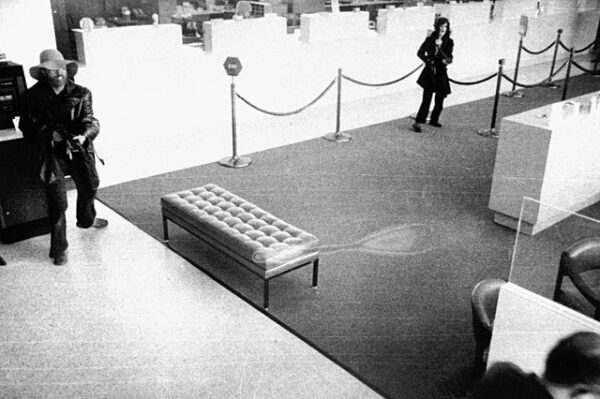
Within weeks, taped messages emerged in which Patty Hearst appeared to identify with her captors. She adopted the name “Tania,” invoked revolutionary slogans, and denounced her former life. By April, she would be photographed wielding a rifle during a bank robbery in San Francisco—an image that stunned the country and blurred the line between coercion and complicity.