
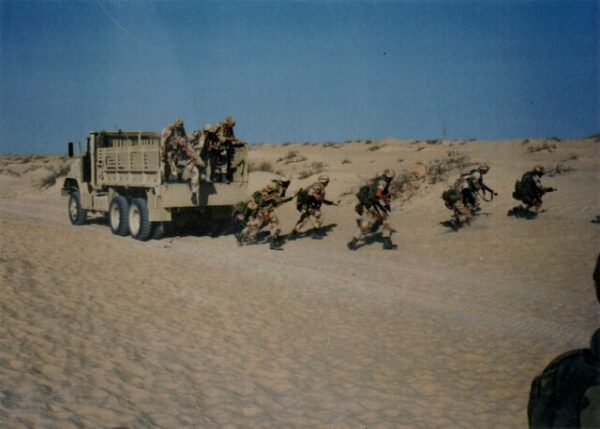
On February 24, 1991, after more than five weeks of relentless aerial bombardment, coalition ground forces surged north across the Saudi Arabian border into Iraq, launching the decisive land campaign of the Gulf War. The moment marked the beginning of the war’s climactic phase—an operation that would shatter Saddam Hussein’s army in just 100 hours and redraw the military balance of the Middle East.
The conflict had begun months earlier. On August 2, 1990, Iraqi forces under President Saddam Hussein invaded neighboring Kuwait, claiming historical rights and accusing the small oil-rich state of economic sabotage. The move triggered global condemnation and swift diplomatic action. Under U.N. authority, a broad international coalition—led by the United States and backed by European, Arab, and Asian allies—assembled in Saudi Arabia. President George H. W. Bush framed the mission in stark terms: Iraq’s aggression would not stand.
The coalition’s initial response came in the form of a massive air campaign. On January 17, 1991, Operation Desert Storm commenced with precision strikes on Iraqi command centers, air defenses, infrastructure, and armored formations. For weeks, coalition aircraft flew thousands of sorties, degrading Iraqi capabilities and isolating frontline units dug into Kuwait and southern Iraq. Satellite-guided munitions, stealth aircraft, and real-time intelligence—hallmarks of a new era in warfare—were showcased before a global television audience.
By late February, coalition commanders judged that Iraqi forces had been sufficiently weakened. The ground offensive, long anticipated, would test that assessment. At 4:00 a.m. local time on February 24, U.S. Marines and Arab coalition forces pushed directly into Kuwait, fixing Iraqi divisions in place. Simultaneously, U.S. Army VII Corps and XVIII Airborne Corps executed a sweeping maneuver westward into the Iraqi desert—a bold “left hook” designed to outflank entrenched Republican Guard units.
The maneuver, conceived under the leadership of Gen. Norman Schwarzkopf Jr., relied on speed and surprise. Rather than assaulting the strongest Iraqi positions head-on, coalition forces bypassed them, cutting off supply lines and escape routes. Armored divisions advanced rapidly across open desert, aided by superior night-vision equipment and communications. Iraqi resistance, though fierce in isolated pockets, quickly collapsed under the combined weight of air power and mobile ground assault.
Within days, Iraqi units began surrendering en masse. Television footage showed columns of disarmed soldiers trudging south under guard, while oil wells in Kuwait burned in thick black plumes—set ablaze by retreating Iraqi forces. On February 26, Iraqi troops began a chaotic withdrawal from Kuwait along the road north to Basra, an event that became known as the “Highway of Death” after coalition aircraft struck retreating convoys.
By February 28, President Bush declared a ceasefire. The ground war had lasted just 100 hours. Kuwait was liberated. Coalition casualties were comparatively light, especially when measured against the scale of the operation and the size of the Iraqi army, once considered the fourth-largest in the world.
Yet the war’s swift conclusion left unresolved questions. Saddam Hussein remained in power. Though weakened, his regime survived internal uprisings in the north and south that were ultimately crushed. The coalition had deliberately chosen not to march on Baghdad, calculating that regime change would fracture the alliance and entangle the United States in a prolonged occupation.

In military terms, the February 24 offensive demonstrated the overwhelming effectiveness of combined-arms maneuver warfare in the post-Cold War era. Precision strikes, air-ground coordination, and coalition interoperability became models for future operations. Strategically, however, the war set the stage for a decade of sanctions, no-fly zones, and periodic clashes that culminated in the 2003 invasion of Iraq.
The crossing of that desert border before dawn in 1991 was brief in duration but immense in consequence. It marked both the end of one phase of American power—the Cold War standoff—and the beginning of another: a period in which U.S. military supremacy would be tested not by superpowers, but by regional conflicts whose aftershocks would reverberate for decades.