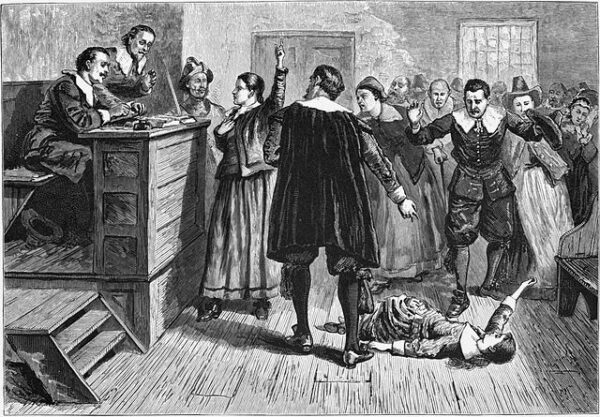
On March 1, 1692, three women were brought before local magistrates in Salem Village, Massachusetts, accused of an invisible crime that would soon convulse an entire region. Their names were Sarah Good, Sarah Osborne, and Tituba. By day’s end, the machinery of accusation had begun to turn. What started as a local inquiry into strange fits and whispered fears would metastasize into one of the most infamous episodes of mass hysteria in American history: the Salem witch trials.
To understand that cold March morning, one must first understand the world in which it unfolded. Late 17th-century Massachusetts was a place of deep piety and deeper anxieties. The Puritan settlers of New England believed themselves engaged in a covenant with God, building a “city upon a hill” in a wilderness they understood not merely as geographic but spiritual. The Devil, they believed, was real, active, and intent on subverting their fragile experiment. Crop failures, frontier wars with Native tribes, smallpox outbreaks, and political uncertainty following the revocation of the Massachusetts charter in 1684 all contributed to a climate of insecurity. Fear was never far from the surface.
In January 1692, the daughter and niece of the village minister, Reverend Samuel Parris, began exhibiting alarming symptoms—violent fits, strange contortions, and unaccountable screams. A local doctor, unable to identify a physical cause, suggested the supernatural. Soon, the afflicted girls named their tormentors. The accusations fell first on three marginal women.
Sarah Good was a homeless beggar, known for muttering curses when refused charity. Sarah Osborne had scandalized her neighbors by living openly with an indentured servant before marriage and by challenging inheritance customs. Tituba, enslaved in the Parris household and of Indigenous or possibly African descent, occupied the lowest rung of Salem’s social hierarchy. Each stood apart from the tight-knit, watchful community. In a village primed to see the Devil’s hand in misfortune, difference could quickly become evidence.
On March 1, the women were examined by local magistrates Jonathan Corwin and John Hathorne in the Salem Village meetinghouse. The proceedings bore little resemblance to modern standards of justice. Spectral evidence—claims that the accused had appeared in spirit to torment victims—was treated as credible. The afflicted girls writhed and screamed in the courtroom, reacting theatrically to the defendants’ glances or gestures. Each twitch was interpreted as confirmation.
Sarah Good and Sarah Osborne denied the charges. Their protests, however, only deepened suspicion. Tituba, by contrast, confessed. Whether coerced, terrified, or calculating that confession might spare her life, she told an elaborate story of the Devil’s book, animal familiars, and other witches operating in the colony. Her testimony electrified the room. What had been isolated accusations now suggested a broader conspiracy—a satanic network embedded within the godly community itself.
Tituba’s confession did not calm Salem; it inflamed it. If there were others, who were they? The logic of fear is expansive. Over the coming months, accusations multiplied. More than 200 people would be accused. Nineteen would be hanged. One man, Giles Corey, would be pressed to death under heavy stones for refusing to enter a plea. Several others would die in jail.

The tragedy of March 1 lies not only in the fate of the three women but in the threshold it represents. A community crossed from suspicion into sanctioned persecution. Legal forms were observed—hearings, warrants, sworn statements—but the substance of justice eroded under the weight of collective panic. The trials revealed how easily religious certainty, social tensions, and personal grievances can fuse into moral crusade.
By the fall of 1692, doubts began to surface. Prominent ministers urged caution about spectral evidence. Governor William Phips eventually dissolved the special Court of Oyer and Terminer. The hysteria subsided as quickly as it had surged. In the years that followed, apologies were issued and some convictions overturned. In 1711, the colony passed legislation restoring rights and providing compensation to certain victims and their families.