On March 2, 1836, amid war and uncertainty, delegates gathered at Washington-on-the-Brazos formally adopted the Texas Declaration of Independence, severing political ties with Mexico and proclaiming the birth of the Republic of Texas. The decision came not in peacetime deliberation but under the shadow of advancing Mexican troops. Even as the convention met, General Antonio López de Santa Anna’s army was laying siege to the Alamo in San Antonio de Béxar. The delegates knew their declaration would either inaugurate a new nation—or condemn them as traitors in a failed rebellion.
The roots of the break stretched back years. During the 1820s, Mexico had encouraged Anglo-American settlement in its northern province of Coahuila y Tejas to stabilize and develop the sparsely populated region. Empresarios such as Stephen F. Austin recruited settlers, who pledged loyalty to Mexico and nominal adherence to Catholicism. But tensions simmered almost from the beginning. Cultural differences, disputes over tariffs and immigration, and especially the issue of slavery—which Mexico had abolished but Texas settlers continued to practice—deepened mistrust between the colonists and Mexico City.
Matters came to a head after Santa Anna abandoned the federalist Constitution of 1824 and centralized power. Many Texans, both Anglo and Tejano, viewed this shift as a betrayal of the federal compact under which they had agreed to settle. Armed resistance erupted in late 1835. By the end of that year, Texian forces had driven Mexican troops from much of the province. Yet Santa Anna’s winter campaign of 1836 signaled that the conflict would not be settled easily.
Against this backdrop, fifty-nine delegates convened in a hastily constructed hall at Washington-on-the-Brazos on March 1. The next day—March 2, coincidentally the birthday of Texas empresario Stephen F. Austin—they unanimously adopted the declaration. Modeled closely on the United States Declaration of Independence, it asserted that when a government becomes destructive of the rights of the people, it is the right of the people to alter or abolish it. The document cataloged grievances against Mexico: the dissolution of state legislatures, the suspension of trial by jury, the imposition of military rule, and the denial of religious and civil liberties.
The declaration’s authors framed their cause in the language of natural rights and constitutionalism, echoing the American revolutionary tradition familiar to many settlers. Yet it also reflected the distinct circumstances of Texas. The document emphasized Mexico’s alleged failure to protect settlers from Native American raids and accused Santa Anna of arbitrary governance. It declared that the people of Texas now constituted “a free, sovereign, and independent republic.”
The convention did more than proclaim independence. Delegates drafted a constitution for the new republic, creating a government with executive, legislative, and judicial branches. They named an interim president, David G. Burnet, and selected Sam Houston as commander-in-chief of the Texian army. These decisions were urgent; Santa Anna’s forces were already pressing deep into Texas.

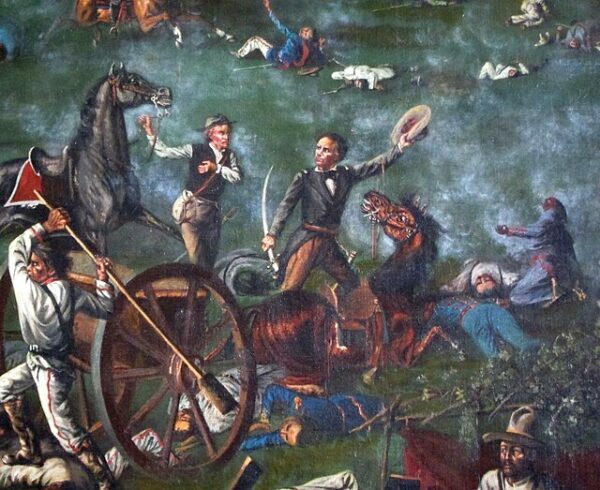
Just four days after the declaration, the Alamo fell. Its defenders, including William B. Travis, James Bowie, and Davy Crockett, were killed. Later in March, Texian prisoners captured at Goliad were executed on Santa Anna’s orders. These events galvanized resistance. Houston retreated eastward, gathering strength, until April 21, 1836, when his army surprised and defeated Santa Anna at the Battle of San Jacinto. The victory secured Texas independence in fact, though Mexico would not formally recognize it.
The adoption of the declaration on March 2 marked the decisive political break. It transformed a regional uprising into a war for national independence and laid the foundation for a republic that would endure nearly a decade. The Republic of Texas would operate as an independent nation until its annexation by the United States in 1845—a move that would help ignite the Mexican-American War and reshape the North American continent.