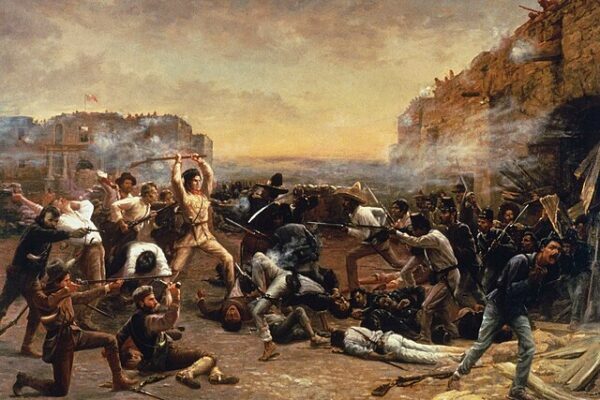
In the early morning darkness of March 6, 1836, the thirteen-day siege of the Alamo reached its violent conclusion. After days of artillery bombardment and tightening encirclement, thousands of Mexican troops surged over the crumbling walls of the former Spanish mission in San Antonio de Béxar. When the smoke cleared, nearly every one of the roughly 187 Texian defenders lay dead.
The fall of the Alamo became one of the defining episodes of the Texas Revolution—a clash not merely of armies but of political visions for the future of Texas.
The conflict itself had been building for years. By the early 1830s, tensions between Anglo settlers in Texas and the Mexican government had escalated sharply. Many Texians—joined by Tejanos who also opposed central authority—resented the policies of Mexican president and general Antonio López de Santa Anna. When Santa Anna abandoned the federalist Mexican Constitution of 1824 in favor of a more centralized regime, resistance hardened into open rebellion.
Texas insurgents began seizing key settlements in late 1835. One of those was San Antonio de Béxar, captured by Texian forces in December after weeks of fighting. The town’s old mission fortress—the Alamo—became a forward defensive position for the revolutionaries, guarding the road from Mexico into the Texas interior.
But the Texian position was precarious from the start.
The Alamo was large but difficult to defend, with walls never designed to withstand sustained artillery fire. The garrison itself was small, composed largely of volunteers. Among its most famous figures were frontiersman Davy Crockett, a former Tennessee congressman who had come west seeking a new beginning, and Colonel James “Jim” Bowie, a legendary knife fighter who had helped command Texian forces earlier in the revolt. Lieutenant Colonel William B. Travis, only 26 years old, commanded the garrison once Bowie fell gravely ill during the siege.
In February 1836, Santa Anna marched north with several thousand Mexican troops determined to crush the rebellion. By February 23, his army reached San Antonio and surrounded the Alamo.
For nearly two weeks the defenders endured constant pressure. Mexican artillery pounded the mission’s walls day and night while Santa Anna’s forces tightened their lines. Travis repeatedly sent messages requesting reinforcements from other Texian units scattered across the frontier.
Help never came in time.
Inside the mission, the defenders faced dwindling supplies and overwhelming odds. Yet they refused to abandon the position. Whether motivated by duty, pride, or belief in the Texian cause, the small garrison held its ground while Santa Anna prepared the final assault.
Before dawn on March 6, Mexican troops advanced in multiple columns toward the Alamo’s walls. The attack was brutal and swift. Texian defenders fired cannon and rifles from the ramparts, inflicting heavy casualties on the attackers, but sheer numbers eventually told. Mexican soldiers breached the defenses and poured into the compound.
Fighting continued room by room in the mission buildings.
Within roughly ninety minutes, the battle was over. Travis was killed early in the assault. Bowie, bedridden by illness, was reportedly shot and bayoneted where he lay. Crockett and the remaining defenders were overwhelmed as Mexican troops secured the fort.
Santa Anna ordered that the bodies of the Texian fighters be burned. Mexican casualties were substantial—estimates often range from 400 to 600 killed or wounded—but the Mexican army had achieved its objective.

The immediate result was a devastating defeat for the Texian rebellion. Yet the psychological effect proved very different.
News of the massacre spread rapidly across Texas and the United States. Rather than crushing the revolutionary cause, the fall of the Alamo galvanized it. The phrase “Remember the Alamo!” soon became a rallying cry for Texian forces gathering under General Sam Houston.
Just six weeks later, on April 21, 1836, Houston’s army met Santa Anna’s forces at the Battle of San Jacinto. In a swift and decisive attack lasting only eighteen minutes, Texian troops defeated the Mexican army and captured Santa Anna himself.
The victory secured Texas’ independence from Mexico.
The Alamo, meanwhile, passed from battlefield into legend. Over time, the doomed stand of its defenders became a powerful symbol in American and Texan memory—an episode in which a small band of volunteers fought against overwhelming odds and died in the cause of independence.