
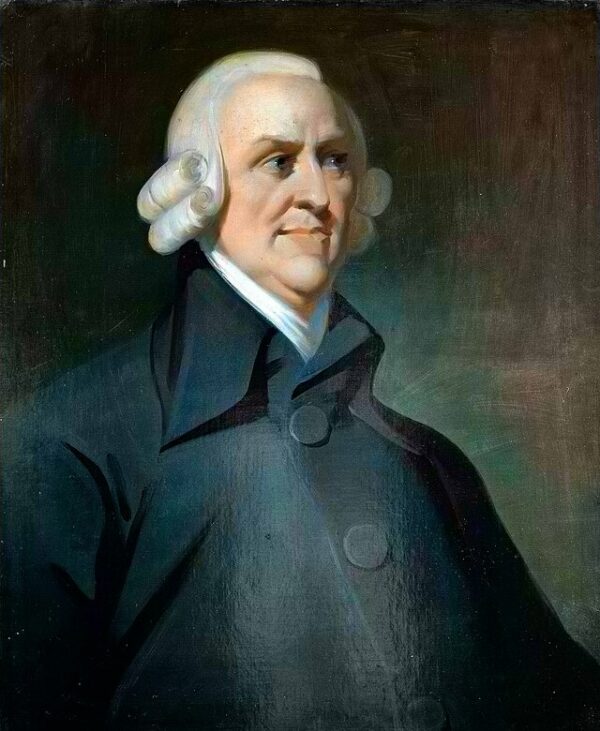
On March 9, 1776, a Scottish philosopher published a book that would reshape the intellectual foundations of economics and politics for centuries to come. The author was Adam Smith, and the book—The Wealth of Nations—offered a sweeping explanation of how nations grow prosperous. With it, Smith launched what later scholars would call the classical era of political economy.
Formally titled An Inquiry into the Nature and Causes of the Wealth of Nations, the work appeared at a moment of dramatic global transformation. The American Revolution had just begun the previous year. European empires dominated global trade networks. Mercantilist doctrine—an economic theory holding that national wealth depended on accumulating gold and maintaining favorable trade balances—guided government policy across the continent.
Smith challenged that worldview directly.
A professor of moral philosophy at the University of Glasgow, Smith had spent years studying the mechanisms of commerce and human behavior. Drawing on lectures delivered in the 1750s and 1760s, as well as observations gathered during travels across Europe, he constructed a systematic critique of the prevailing economic orthodoxy. Governments, Smith argued, often misunderstood how wealth was actually created.
The key driver of prosperity, he insisted, was not government hoarding of precious metals but productive labor.
One of Smith’s most famous illustrations appears early in the book: the example of a small pin factory. If a single worker attempted to produce pins alone, Smith explained, he might make only a handful each day. But if the work were divided into specialized tasks—drawing wire, cutting it, sharpening it, attaching the head—productivity could skyrocket. Through this “division of labor,” ten workers might collectively produce thousands of pins daily.
Specialization, Smith argued, dramatically increased efficiency and output. It was not simply a factory trick but a principle that operated throughout the entire economy.
Markets, in Smith’s framework, coordinated this activity through voluntary exchange. Individuals pursuing their own interests—seeking profit, wages, or opportunity—often unintentionally produced broader social benefits. Smith described this process through one of the most enduring metaphors in economic thought: the “invisible hand.”
In competitive markets, prices transmitted information about supply, demand, and scarcity. Entrepreneurs responded by shifting resources where they were most valued. The resulting system, Smith suggested, generated order without the need for centralized direction.
This did not mean Smith rejected government entirely. Far from it. In The Wealth of Nations, he assigned the state several essential roles: protecting society through national defense, administering justice, and building certain public works—such as roads, bridges, and canals—that private actors might not profitably provide.
But he warned repeatedly about excessive state interference in commerce. Tariffs, monopolies, and restrictive guild systems—hallmarks of mercantilist policy—often benefited politically connected groups while reducing overall prosperity.
Smith’s arguments emerged partly from debates among thinkers of the Scottish Enlightenment, a vibrant intellectual movement that included figures like David Hume. These scholars explored how reason, observation, and human behavior shaped institutions and society.
Yet the scope of The Wealth of Nations went far beyond academic debate. The book offered policymakers a new framework for understanding trade, taxation, and economic development. Over the next century, Smith’s ideas would influence generations of economists and reformers.
Thinkers such as David Ricardo and John Stuart Mill built upon Smith’s foundations, developing theories of comparative advantage, labor value, and market competition that defined classical economics in the nineteenth century.

The book’s impact extended beyond Britain. In the United States, debates over tariffs, banking, and industrial policy frequently drew on Smithian arguments about free trade and market competition.
Even critics engaged with Smith’s framework. Nineteenth-century socialist thinkers, including Karl Marx, began their critiques of capitalism by grappling directly with the analytical tools Smith had introduced.
More than two centuries later, The Wealth of Nations remains one of the most influential works ever written about economic life. Its pages combine philosophy, history, and practical observation in an attempt to explain a deceptively simple question: why do some nations grow wealthy while others remain poor?
Smith’s answer—rooted in markets, labor, and human incentives—helped inaugurate the modern study of economics.