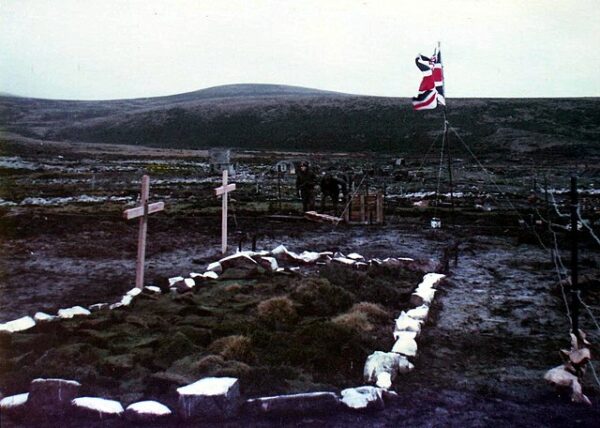
On March 19, 1982, a small and seemingly obscure landing on a remote sub-Antarctic island set in motion one of the last conventional wars of the late Cold War era. That morning, a group of Argentine personnel—nominally scrap metal workers but accompanied by military elements—raised their flag on South Georgia Island, a British-administered territory some 800 miles east of the Falkland Islands. What might have passed as a minor diplomatic incident instead became the opening move in a conflict that would, within weeks, draw two nations into open war.
South Georgia was no strategic prize in the conventional sense. Windswept, mountainous, and largely uninhabited, it held a small British research station and little else. Yet in geopolitics, symbolism often outweighs material value. For Argentina’s ruling military junta, led by General Leopoldo Galtieri, the island formed part of a broader territorial claim over the Falklands—known in Argentina as Las Malvinas—and surrounding dependencies. That claim, long embedded in Argentine political identity, had grown more urgent as the regime faced mounting economic crisis, public unrest, and a legitimacy deficit at home.
The landing at South Georgia was not, strictly speaking, an invasion. It began as a commercial venture: an Argentine scrap dealer had contracted to dismantle abandoned whaling stations on the island. But the operation quickly took on a different character. Argentine personnel arrived aboard the transport ship Bahía Buen Suceso, raised the national flag without British authorization, and refused to comply with requests from the small Royal Navy presence to lower it. British authorities, caught off guard, viewed the act as a direct challenge to sovereignty.
In London, the response was cautious at first but increasingly firm. Prime Minister Margaret Thatcher’s government, already under domestic pressure, recognized the broader implications. If Argentina could establish a foothold on South Georgia without consequence, the Falklands themselves—home to roughly 1,800 British citizens—would be next. The island landing thus became less about South Georgia itself and more about what it signaled: a test of British resolve.
That test came swiftly. On April 2, just two weeks after the South Georgia incident, Argentine forces launched a full-scale invasion of the Falkland Islands, overwhelming the small British garrison at Port Stanley. The earlier landing had not merely “precipitated” the war; it had revealed the junta’s willingness to act—and Britain’s initial uncertainty in response. The ambiguity of March 19 gave way to the clarity of April 2: a territorial seizure that could not be ignored.
The British reaction, once galvanized, was decisive. Within days, Thatcher ordered a naval task force to sail 8,000 miles दक्षिण into the South Atlantic, a logistical undertaking of extraordinary scale. Aircraft carriers, destroyers, submarines, and support vessels assembled in what would become the largest British naval deployment since World War II. The objective was unambiguous: retake the Falklands and restore British control.

South Georgia itself would become an early target. In late April, British forces moved to reclaim the island in Operation Paraquet. After a series of engagements involving Royal Marines, Special Air Service units, and naval gunfire, Argentine forces on South Georgia surrendered on April 25. The message was clear—broadcast famously in Thatcher’s understated words: “The White Ensign flies alongside the Union Jack in South Georgia. God save the Queen.”
The broader war, however, would prove far more costly. Over the course of ten weeks, British and Argentine forces clashed at sea, in the air, and on the rugged terrain of the Falklands. By the time Argentine troops surrendered on June 14, 1982, more than 900 people had been killed.