
On March 24, 1199, Richard I of England—the warrior-king whose legend had been forged in the campaigns of the Third Crusade—was struck by a crossbow bolt while besieging a minor fortress in southwestern France. The wound, sustained at the castle of Châlus-Chabrol Castle, would prove fatal, bringing to a close one of the most martial and mythologized reigns of the medieval English monarchy.
Richard’s final campaign was not waged in the Holy Land, but in the contested territories of his French dominions, where he was attempting to suppress a rebellion and secure treasure rumored to have been discovered at Châlus. Though the castle itself was small and of limited strategic value, the king’s presence underscored his governing style—direct, forceful, and personally engaged in warfare. Richard, unlike many monarchs of his era, regularly placed himself in harm’s way, a trait that earned admiration among his followers and consternation among his advisors.
According to contemporary chroniclers, the king was inspecting the siege lines without the full protection of armor when a defender—often identified as a young crossbowman—took aim from the castle walls. The bolt struck Richard in the shoulder or neck, depending on the account, embedding itself deeply. Though not immediately fatal, the wound quickly deteriorated, likely exacerbated by infection, a common and often deadly complication in medieval warfare.
Richard was carried to his camp, where surgeons attempted to remove the bolt. The procedure, performed without the benefit of modern antiseptic techniques, failed to prevent the onset of gangrene. Over the following days, his condition worsened, and it became clear that the king would not recover. Even in his final moments, however, Richard’s conduct contributed to the enduring mythology surrounding him.
In a gesture frequently cited by chroniclers, Richard is said to have forgiven the crossbowman who shot him. The young man, brought before the dying king, reportedly expected execution. Instead, Richard ordered that he be spared and even rewarded—a decision that has been interpreted variously as an act of chivalric magnanimity or as a calculated effort to shape his legacy. Whether apocryphal or authentic, the story reflects the ideals of knighthood and honor that were central to Richard’s reputation.
He died on April 6, 1199, at the age of 41. His death marked the end of a reign defined less by domestic governance than by near-constant military engagement. Richard had spent much of his ten-year reign outside England, first on crusade and later defending his continental possessions against rivals such as Philip II of France. While his absence drew criticism from some contemporaries and later historians, his military prowess and personal bravery secured his place as one of the most celebrated warrior-kings in European history.

The succession passed to his younger brother, John of England, whose reign would take a markedly different course. Unlike Richard, John faced internal dissent and baronial resistance, culminating in the sealing of the Magna Carta in 1215. In this sense, Richard’s death not only ended a chapter of crusading kingship but also set the stage for a transformation in the relationship between the English crown and its subjects.
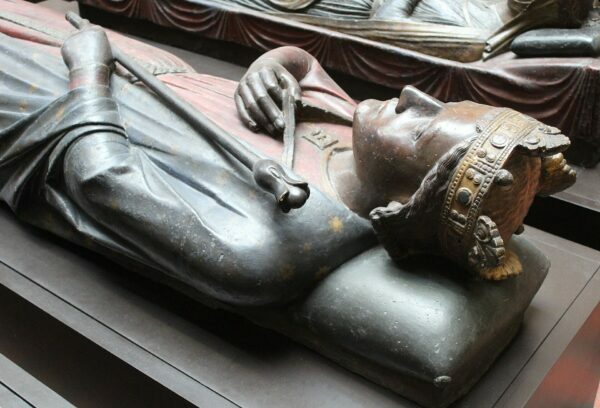
Richard’s remains were divided in accordance with medieval custom: his heart was buried in Rouen, symbolically tied to his Norman lands; his body was interred at Fontevraud Abbey alongside his father, Henry II; and other relics were distributed across his territories. This fragmentation reflected the composite nature of his rule—a king of England, yes, but equally a ruler of vast French domains whose political and military energies were largely directed across the Channel.