On March 25, 1965, a column of civil rights activists led by Martin Luther King Jr. completed a 50-mile march from Selma to Montgomery, Alabama, bringing to a dramatic close one of the most consequential demonstrations of the civil rights era. The four-day journey, conducted under the protection of federalized National Guard troops, marked both a tactical victory for the movement and a turning point in the national debate over voting rights.
The march did not begin as a show of strength. It emerged from frustration and violence. In Selma, African American citizens seeking to register to vote faced systematic obstruction—literacy tests, arbitrary rejections, and outright intimidation. Local authorities, led by Dallas County Sheriff Jim Clark, enforced these barriers with open hostility. The situation reached a breaking point on March 7, when a group of marchers attempting to cross the Edmund Pettus Bridge were met by state troopers and deputized posses. The confrontation, later known as “Bloody Sunday,” left dozens injured and shocked a national television audience.
Two days later, King led a symbolic second attempt. Confronted again by a line of troopers, he turned the marchers around rather than risk further bloodshed without federal protection. That decision drew criticism from some activists but bought time for a legal and political strategy to take shape. A federal court soon authorized the march, and President Lyndon B. Johnson ordered Alabama National Guard units into federal service to protect the demonstrators. The stage was set for a third attempt—this time under the watch of the federal government.
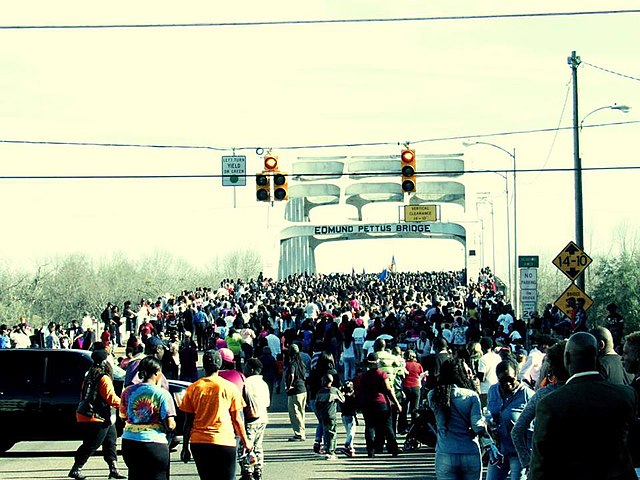
The march began in earnest on March 21. Roughly 3,200 participants set out from Selma, crossing the same bridge that had become a symbol of state violence. The early days were disciplined and deliberate. Marchers advanced about 10 to 15 miles per day, camping along U.S. Highway 80 under tight security. As they moved eastward, the procession became both a protest and a pilgrimage. Clergy, students, labor activists, and ordinary citizens joined along the route, transforming the march into a broad coalition that reflected the movement’s growing national reach.
By the time the marchers approached Montgomery, their numbers had swelled to an estimated 25,000. The final stretch into the state capital carried a sense of inevitability. The spectacle of thousands walking peacefully under federal protection stood in stark contrast to the violence that had defined earlier confrontations. It was a visual argument, as much as a political one, that the denial of voting rights could no longer be defended as a matter of local control.
At the Alabama State Capitol, King delivered a speech that distilled the moral and strategic purpose of the march. “How long? Not long,” he declared, framing the struggle for voting rights as both urgent and ultimately unstoppable. The speech drew on the language of faith and constitutional promise, linking the immediate demands of the movement to a broader American narrative of justice and equality.
The immediate political impact was significant. President Johnson had already addressed Congress on March 15, invoking the language of the movement—“We shall overcome”—and introducing legislation that would become the Voting Rights Act of 1965. The successful completion of the Selma-to-Montgomery march reinforced the urgency of that effort. It provided lawmakers with a clear demonstration of both the depth of disenfranchisement in the South and the national support for federal intervention.

Within months, Congress passed the Voting Rights Act, outlawing discriminatory practices and authorizing federal oversight of elections in jurisdictions with a history of suppression. The law would dramatically increase voter registration among African Americans across the South and reshape the political landscape for generations.
The march from Selma to Montgomery did not end the struggle for civil rights, nor did it resolve the deeper social and economic inequalities that persisted. But it clarified the stakes and altered the balance of power. By combining disciplined protest with legal strategy and federal engagement, the movement forced the country to confront a contradiction at the heart of its democracy.