
On March 26, 1997, sheriff’s deputies in Rancho Santa Fe entered a quiet, upscale home and encountered a scene that would quickly become one of the most unsettling episodes in modern American religious history. Inside, they found 39 bodies, all carefully arranged, all dressed identically, and all participants in what would soon be identified as the mass suicide of the group known as Heaven’s Gate.
The discovery did not come entirely out of nowhere. Authorities had been alerted after a former member received a package containing a videotape. When viewed, it revealed calm, deliberate messages from group members explaining their decision to “exit” their physical bodies. By the time deputies arrived at the residence, the act had already been completed over the course of several days.
Heaven’s Gate had been founded in the 1970s by Marshall Applewhite and his partner Bonnie Nettles, who together constructed a belief system that blended elements of Christianity, science fiction, and apocalyptic expectation. Followers were taught that Earth was on the verge of being “recycled,” and that salvation required leaving behind their human bodies to ascend to a higher, extraterrestrial level of existence.
By March 1997, the group had become fixated on the appearance of the Comet Hale-Bopp, one of the brightest comets visible from Earth in decades. Within Heaven’s Gate doctrine, the comet took on extraordinary significance. Applewhite and his followers came to believe that a spacecraft was trailing behind it—an opportunity, they said, for believers to leave Earth and join what they viewed as a more advanced, non-human realm.
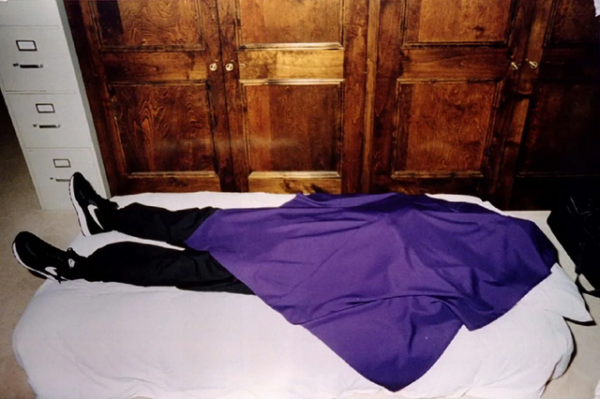
The group’s final days were marked not by chaos but by an eerie orderliness. Members recorded farewell videos, speaking in composed tones about their readiness to leave their human existence behind. They wore matching black clothing, Nike sneakers, and armbands bearing the phrase “Heaven’s Gate Away Team.” Each participant carried a small amount of money and identification, as if anticipating a journey rather than an end.
The suicides themselves were carried out in stages. Members ingested a mixture of phenobarbital and alcohol, then lay down in bunk beds or on mattresses, covering themselves with purple shrouds. Those who died first were attended to by others, who then followed in subsequent waves. In total, 21 women and 18 men, ranging in age from their twenties to their seventies, died in what investigators concluded was a coordinated and voluntary act.
News of the discovery spread rapidly, amplified by the growing reach of the internet, which Heaven’s Gate itself had used to disseminate its teachings. The group maintained a website that outlined its beliefs with unusual clarity, offering a window into a worldview that many observers found both perplexing and chilling. Unlike earlier isolated sects, Heaven’s Gate had left behind a digital footprint, allowing the public to examine its internal logic in real time.
The event quickly drew comparisons to earlier tragedies involving insular religious movements, but it also marked a distinctly late-20th-century phenomenon. The blending of technological literacy with apocalyptic belief created a hybrid form of communal identity—one that was at once deeply personal and globally visible. The group’s members were not cut off from modern society in the traditional sense; many were educated, technologically skilled, and capable of navigating the contemporary world even as they rejected its underlying assumptions.

In the aftermath, law enforcement and scholars sought to understand how such a large group could arrive at a shared decision to die. Investigations found no evidence of coercion in the conventional sense. Instead, the group’s internal culture, shaped over decades, had produced a closed system of belief in which leaving Earth was framed as a necessary step to reach what they believed was a higher existence.
The house in Rancho Santa Fe soon became a focal point for media coverage and public reflection, a physical reminder of how belief, when insulated from external challenge, can evolve into something both coherent and catastrophic. Families of the deceased grappled with the loss, often expressing shock at how completely their loved ones had embraced the group’s teachings.