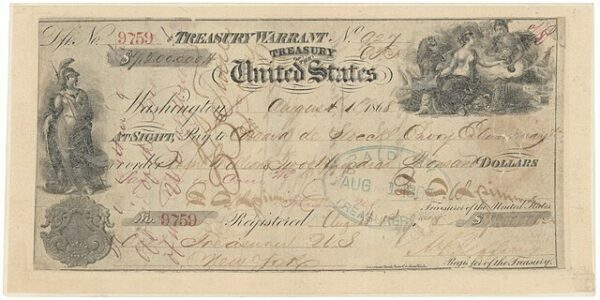
On March 30, 1867, the United States completed one of the most consequential land acquisitions in its history, purchasing Alaska from the Russian Empire for $7.2 million—roughly two cents per acre. The agreement, negotiated by William H. Seward under the administration of Andrew Johnson, dramatically expanded the nation’s territory and, in time, reshaped its economic and strategic horizons.
At the moment of its signing, however, the deal was widely ridiculed. Critics derided the acquisition as “Seward’s Folly” or “Seward’s Icebox,” mocking the notion that the United States would pay millions for what many perceived as a frozen, barren wilderness. Newspapers and political opponents questioned Seward’s judgment, arguing that the remote territory offered little immediate value and would be costly to defend and administer. Yet Seward, a committed expansionist, saw Alaska not as an icy liability but as a long-term investment in America’s future.
Russia’s willingness to sell the territory stemmed from both economic strain and geopolitical calculation. The empire, ruled by Alexander II, had struggled to maintain its distant North American outpost. Following its defeat in the Crimean War, Russia faced mounting financial pressures and recognized that Alaska would be difficult to defend against potential British aggression from neighboring Canada. Rather than risk losing the territory without compensation in a future conflict, Russian officials opted to sell it to the United States, a nation seen as a strategic counterweight to British influence in North America.
Negotiations between Seward and the Russian minister to the United States, Eduard de Stoeckl, moved quickly. After months of discussion, the two men reached an agreement in the early hours of March 30. The treaty was signed at 4 a.m. in Washington, D.C., reflecting both urgency and secrecy. Seward, eager to secure Senate approval before opposition could mount, wasted little time presenting the treaty for ratification.
The Senate approved the purchase on April 9, 1867, by a vote of 37 to 2, though skepticism lingered among the public. Formal transfer of the territory took place later that year, on October 18, in the settlement of Sitka, where Russian officials ceremonially lowered their flag and American forces raised the Stars and Stripes. The United States had acquired more than 586,000 square miles of land, increasing its size by nearly one-fifth.
In the decades that followed, the wisdom of the purchase became increasingly apparent. Alaska proved rich in natural resources, beginning with the Klondike Gold Rush in the late 1890s, which drew tens of thousands of prospectors northward. Subsequent discoveries of copper, oil, and other minerals further underscored the territory’s economic value. By the 20th century, Alaska had become a key source of energy and raw materials, contributing significantly to the nation’s industrial growth.
Strategically, Alaska also assumed immense importance. Its location, bordering the Arctic and situated across the Bering Strait from Russia, gave the United States a critical foothold in the North Pacific. During World War II and the Cold War, Alaska’s military significance became undeniable, serving as a base for defense operations and early warning systems against potential adversaries.

What had once been dismissed as a foolish gamble came to be regarded as a masterstroke of diplomacy and foresight. Seward himself did not live to see Alaska’s full transformation, but history ultimately vindicated his vision. Today, the purchase stands as a defining example of American expansionism and the enduring value of long-term strategic thinking.
The Alaska Purchase, as it is now known, reflects a broader pattern in American history: decisions that appear questionable in their own time can, with the passage of years, reveal their true significance. In acquiring Alaska, the United States not only gained vast territory but also secured a future shaped by resources, opportunity, and global influence—outcomes that far exceeded the modest price paid on that early spring morning in 1867.