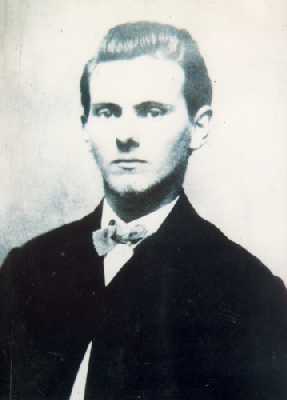
On April 3, 1882, in the quiet Missouri town of St. Joseph, one of the most famous outlaws of the American West met an unceremonious end. Jesse James—bank robber, Confederate guerrilla, and folk hero to some—was shot in the back of the head by a man he trusted: Robert Ford. The killing did not occur in a dusty street amid a hail of gunfire, but inside a rented home, while James stood on a chair adjusting a picture on the wall.
By 1882, Jesse James had already become a legend. Born in 1847 in Missouri, he came of age amid the violence of the Civil War along the Kansas-Missouri border—a region riven by guerrilla warfare and personal vendettas. As a member of pro-Confederate partisan bands led by figures like William Quantrill and “Bloody Bill” Anderson, James participated in brutal raids that blurred any distinction between combatant and outlaw. When the war ended, the habits—and networks—of irregular violence remained. James, along with his brother Frank, turned to robbery, forming the James-Younger Gang with the Younger brothers and other associates.
Throughout the late 1860s and 1870s, the gang carried out a series of high-profile bank and train robberies across Missouri, Iowa, Minnesota, and beyond. Their exploits were amplified by sympathetic newspapers, which cast James as a kind of Southern Robin Hood, striking at powerful financial institutions and railroads. This image bore little resemblance to reality—many of the gang’s robberies involved civilian casualties—but it proved durable. In a region still resentful over the outcome of the Civil War and the disruptions of Reconstruction, Jesse James became a folk hero as much as a criminal.
That myth began to unravel after the gang’s disastrous attempt to rob the First National Bank of Northfield, Minnesota, in 1876. The raid ended in failure, with several gang members killed or captured by armed townspeople. The Younger brothers were imprisoned, and the James brothers fled back to Missouri. Though Frank and Jesse continued to commit robberies, the scale and cohesion of their operations diminished. Increasingly isolated, Jesse relied on a smaller circle of accomplices—and that narrowing circle would prove fatal.
Among those drawn into James’s orbit were brothers Robert and Charley Ford, young men eager to make a name for themselves. Robert Ford, in particular, idolized Jesse James, reportedly memorizing stories of his exploits. Yet admiration soon gave way to calculation. Missouri authorities, along with railroad interests, had placed a substantial reward on James’s head, and Governor Thomas T. Crittenden was under pressure to bring the outlaw to justice. Through intermediaries, the Fords entered into a secret arrangement: in exchange for killing Jesse James, they would receive the reward and likely a pardon for their own crimes.
On the morning of April 3, Jesse James was at home with his wife and children. The atmosphere was deceptively calm. At one point, noticing that a picture on the wall was crooked, James removed his gun belt and climbed onto a chair to straighten it. In that moment—unarmed, his back turned—Robert Ford drew his revolver and fired a single shot into the back of James’s head. The most wanted man in the West died instantly.
The killing shocked the nation, not for its violence but for its perceived treachery. Ford had not faced James in a duel or even a confrontation; he had shot him from behind. Rather than being celebrated as a lawman or hero, Ford was widely condemned as a coward. Newspapers derided him as “the dirty little coward” who betrayed his friend for money. The romantic image of Jesse James only grew in death, while Ford found himself cast as a villain in the story.

In a twist that underscored the ambiguities of frontier justice, Robert and Charley Ford were quickly arrested, tried, and convicted for the murder—but almost immediately pardoned by Governor Crittenden, as had been quietly promised. The reward money proved elusive, however, and Ford struggled to capitalize on his notoriety. He even attempted to stage reenactments of the killing on tour, but public hostility followed him.
Robert Ford’s life after April 3 was marked by instability and resentment. He drifted through various ventures, never escaping the shadow of his act. In 1892, a decade after killing Jesse James, Ford himself was shot and killed in Colorado by a man named Edward O’Kelley, who reportedly sought revenge or notoriety of his own.