
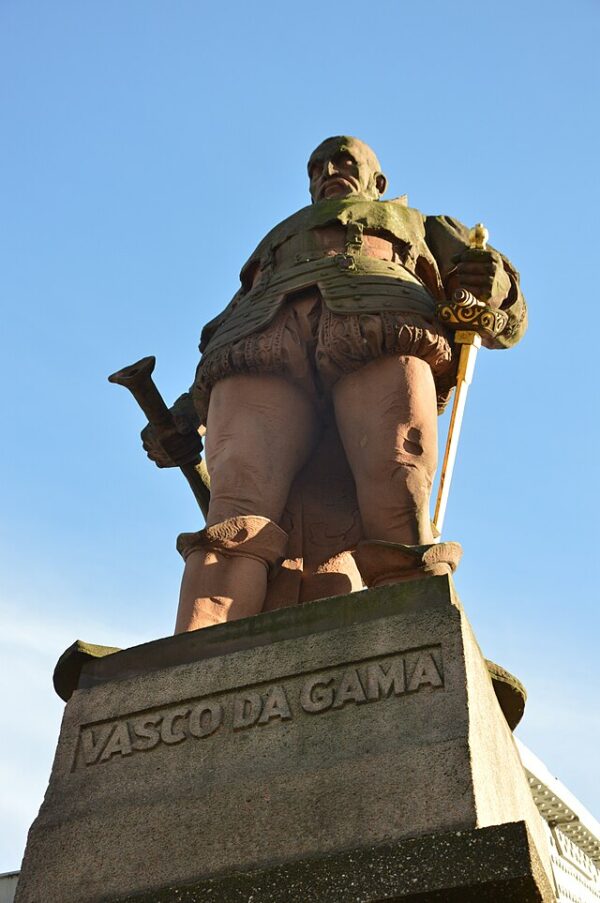
On July 8, 1497, a small Portuguese fleet led by Vasco da Gama set sail from the port of Lisbon, embarking on one of the most consequential voyages in world history. Commanding four ships under the patronage of King Manuel I, da Gama’s mission was bold and clear: find a direct maritime route to the riches of India by sailing around the southern tip of Africa. This expedition would shatter medieval geographic assumptions, alter global trade forever, and usher in a new era of European imperialism in Asia.
At the time, the spice trade was among the most lucrative markets in Europe. Cloves, cinnamon, nutmeg, and black pepper were highly sought after, not only for their culinary uses but for their value in medicine and preservation. However, spices reached Europe through a long, complex, and expensive land-and-sea network dominated by Muslim and Venetian merchants. The Portuguese crown, having recently completed its Reconquista and expanding naval reach down the African coast, saw an opportunity to bypass the overland routes entirely. The solution was to find a sea passage around Africa to reach the Indian subcontinent directly.
Vasco da Gama, though not an experienced navigator by the standards of the time, was chosen for his noble lineage and political reliability. His fleet consisted of four vessels: the flagship São Gabriel, its twin São Rafael, a caravel named Berrio, and a supply ship. The fleet was stocked with interpreters, priests, and gifts for potential local rulers, as well as weapons in case of hostility.
Da Gama’s voyage followed in the wake of earlier Portuguese expeditions. Bartolomeu Dias had already rounded the Cape of Good Hope in 1488, proving that the Indian Ocean could be reached from the Atlantic.
However, Dias had turned back before venturing far into the Indian Ocean itself. Da Gama’s task was to press on beyond that point, cross the uncharted waters of the southern Indian Ocean, and arrive in the fabled markets of Calicut or beyond.
The fleet rounded the Cape of Good Hope in November 1497 and made its way up the eastern coast of Africa. Along the Swahili Coast—particularly in Mozambique and Mombasa—da Gama encountered Arab traders and Muslim rulers who were wary of the newcomers. While some ports, like Malindi (in modern-day Kenya), proved more cooperative and even provided an experienced pilot named Ahmad ibn Majid or perhaps a local Indian Muslim navigator, other encounters were tense and hostile.
With the pilot’s help, the Portuguese crossed the open ocean and arrived at Calicut (modern Kozhikode) on the Malabar Coast of India in May 1498, nearly ten months after departing Lisbon. The arrival was both triumphant and fraught. Though da Gama succeeded in establishing contact with the Hindu ruler, the Zamorin of Calicut, negotiations were strained. The Portuguese gifts, including woolen cloth, corals, and basins, were considered underwhelming in a land accustomed to gold and jewels from Persian, Arab, and Chinese merchants. Nevertheless, the journey had achieved its principal aim—Europe had found a direct sea route to India.

Vasco da Gama’s return voyage was arduous and deadly. Many of his crew died from scurvy, and the fleet suffered from monsoon winds and misnavigation. Still, when da Gama returned to Portugal in 1499, he was received as a national hero. The voyage proved that a maritime link to Asia was not only possible, but potentially profitable.
The consequences were vast. Within a few years, Portuguese trading posts and fortresses would line the coasts of Africa, India, and eventually Southeast Asia. The monopoly that Muslim and Venetian traders had enjoyed over Eastern goods was broken. European powers now had both the means and the motivation to dominate global trade, setting in motion centuries of colonial expansion.