On December 3, 1775—six months after Lexington and Concord, and amid the halting, improvisational birth of a Continental Navy—the newly commissioned USS Alfred unfurled a banner no American warship had ever carried. It was not yet the “Stars and Stripes,” nor anything immediately recognizable as the national emblem that would soon circle the globe, but for contemporaries it was a quiet, unmistakable assertion: the colonies were no longer merely petitioners. They were a people preparing to defend themselves on the open sea.
The moment belonged to a young naval officer named John Paul Jones, then a newly minted first lieutenant, whose name would soon become synonymous with American seapower. When Jones stepped forward to raise the Continental Union Flag—sometimes called the “Grand Union Flag”—he was not simply performing a ceremonial gesture. He was announcing that the Congress now claimed a navy of its own, however small, and that its vessels sailed under a unified political authority rather than the disparate colonial flags that had marked earlier privateers.
The Alfred herself was an unlikely national symbol: a former merchant vessel hastily repurposed as the flagship of the infant fleet. Congress had authorized just a handful of ships, all converted and refitted in Philadelphia and neighboring ports, and none of them remotely comparable to the professional men-of-war commanded by the Royal Navy. But for a movement that had begun the year without a single military institution beyond local militias, even the improvised navy represented a startling escalation.
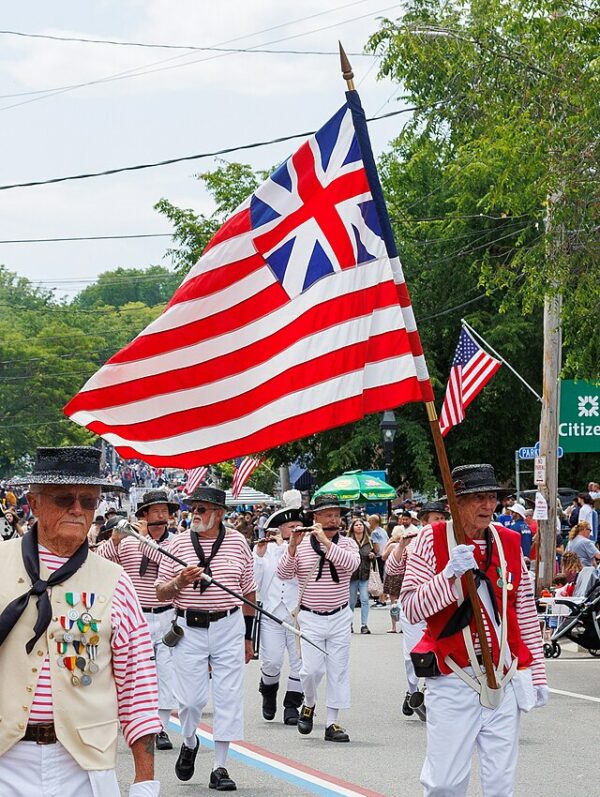
The flag that rose above the deck that December morning captured this reality. Its design featured thirteen red-and-white stripes—one for each colony—united beneath the familiar British Union Jack in the canton. It was a paradoxical emblem: a nationalist assertion built on imperial imagery, a demand for colonial rights expressed through the very symbol of the authority denying them. Yet for colonists in late 1775, the Union Jack did not yet represent tyranny in the way it soon would. Many still imagined reconciliation as possible, even desirable, so long as Parliament abandoned its claims to legislate for the colonies “in all cases whatsoever.”
Thus the Continental Union Flag was both a declaration and a hedge, a signal of unity without a final break. But the act of hoisting it—especially at sea—pushed events toward an irreversible direction. By placing a common ensign on a commissioned warship, Congress was doing something that no petition or pamphlet could accomplish: it was behaving like a sovereign government.
Jones grasped the symbolic weight instantly. Although he left no detailed diary entry of the event, his later writings are saturated with the conviction that naval warfare would decide whether the colonies could survive as a nation. On Alfred and later on Ranger, Bonhomme Richard, and Alliance, Jones treated the flag—whatever its evolving form—as a statement of political legitimacy. If the British were to regard American sailors as pirates, he argued, then America must fight with the discipline and daring of a navy determined to earn its place among states.
The reaction in London confirmed his instincts. By early 1776, British officials were alarmed not by the size of the American fleet—which they correctly dismissed as negligible—but by the brazenness of its existence. Naval power implied sovereignty, and sovereignty implied independence. Even the Continental Union Flag, with its still-British canton, was understood as a challenge: a set of rebellious provinces claiming the right to organize militarily outside the Crown’s control.

Within two years, the flag would be replaced by the more familiar Stars and Stripes, ratified by Congress in June 1777 and rapidly adopted aboard American vessels. The Union Jack in the canton would disappear, and with it the last visual remnant of political compromise. But the essential moment—the transformation of a restless colonial confederation into a polity willing to contest command of the seas—arrived earlier, on that cold December day in 1775.
The Alfred’s flag raising did not provoke the thunder of battle, nor did it resolve the constitutional questions tearing the empire apart. Yet it marked a decisive psychological turn. A nation that builds a navy intends to endure. And a nation that raises a flag at sea expects the world to take notice