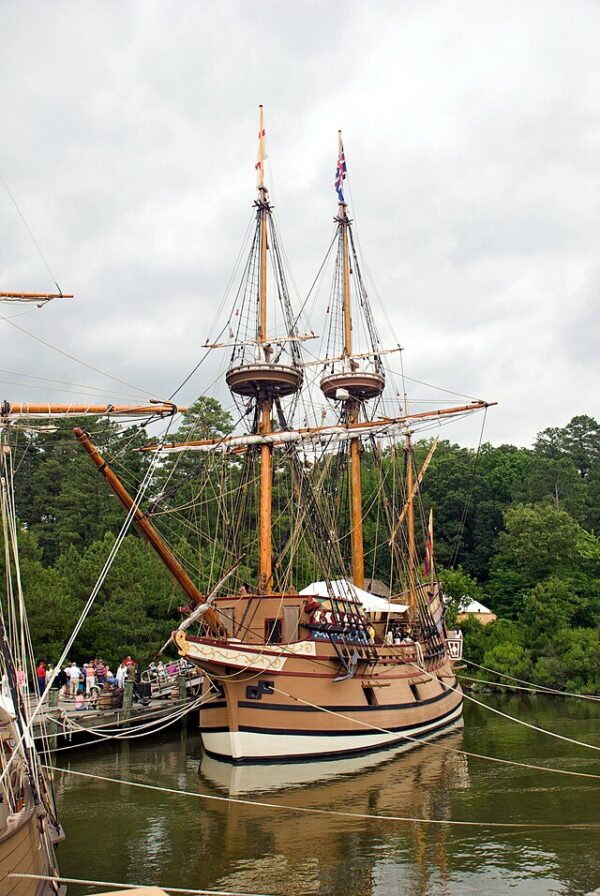
On December 19, 1606, three small ships slipped their moorings in England and headed west into the Atlantic, carrying with them an experiment whose consequences would reshape world history. The Susan Constant, the Godspeed, and the Discovery departed under the authority of the Virginia Company of London, bound for the coast of North America. Their destination was uncertain, their survival far from guaranteed. Yet from this departure would emerge Jamestown, Virginia—the first permanent English settlement in what would become the United States, and the earliest of the thirteen colonies.
The voyage itself was modest in scale but immense in ambition. The three vessels carried roughly 104 men and boys, chosen not primarily for farming or frontier survival but for profit-making ventures. Many were gentlemen, artisans, or laborers sent to search for gold, establish trade, and secure England’s geopolitical claims against Spanish expansion. Captain Christopher Newport commanded the expedition, while leadership ashore would later fall to a fractious council that included figures such as Edward Maria Wingfield and the young soldier of fortune John Smith.
The ships’ departure came at a moment of intense imperial rivalry. Spain dominated much of the Americas, extracting wealth through conquest and coercion. England, a relative latecomer, sought a foothold that would provide raw materials, open new markets, and enhance national prestige. The Virginia Company framed the mission in lofty terms—spreading Christianity, civilizing “heathen” lands—but its investors expected tangible returns. Colonization was as much a financial gamble as a political one.
After a grueling four-month voyage, the ships reached the Chesapeake Bay in April 1607 and selected a marshy peninsula along the James River as their settlement site. They named it Jamestown, in honor of King James I. The location offered defensive advantages against potential Spanish attack, but it came at a steep cost. The brackish water bred disease, the soil proved poor for agriculture, and the surrounding environment was unfamiliar and unforgiving.
Relations with the local Powhatan Confederacy were complex from the outset. Initial encounters alternated between cautious trade and violent skirmishes. While moments of cooperation occurred—famously associated, if mythologized, with Pocahontas—the broader relationship was defined by mutual suspicion and escalating conflict. The English depended on Native American food supplies, even as their presence disrupted existing political and economic systems.
Jamestown’s early years were marked by near-collapse. Starvation, disease, and internal discord decimated the population. During the winter of 1609–1610, known grimly as the “Starving Time,” only about 60 of roughly 500 settlers survived. Cannibalism, once dismissed as rumor, has since been confirmed by archaeological evidence. The colony endured not because it was well planned, but because it was stubbornly sustained—reinforced by new arrivals and backed by investors unwilling to concede failure.

The settlement’s fortunes changed with the introduction of tobacco cultivation by John Rolfe in the 1610s. Tobacco proved wildly profitable, transforming Jamestown from a precarious outpost into a viable economic enterprise. This shift, however, came with profound moral and social consequences. Large-scale tobacco farming demanded land and labor, accelerating the dispossession of Native Americans and laying the groundwork for a labor system that would soon rely heavily on enslaved Africans. In 1619, the first recorded Africans arrived in Virginia, marking the beginning of institutionalized slavery in English North America.
The Susan Constant, Godspeed, and Discovery helped launch the seedbed of enduring institutions—representative government, private property, and English common law—that would shape American political culture. In 1619, the Virginia colony convened the House of Burgesses, the first representative legislative assembly in the New World.