
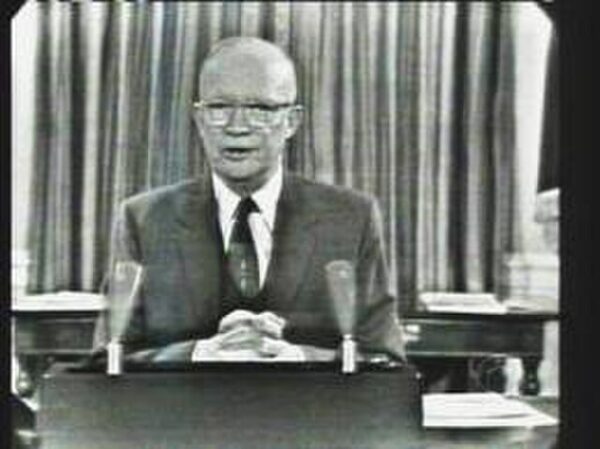
On January 17, 1961—just three days before leaving office—Dwight D. Eisenhower delivered a televised farewell address that would outlast nearly every other valedictory speech in American history. Calm in delivery but sober in judgment, the address reflected the perspective of a career soldier turned president who had spent eight years managing the permanent anxieties of the Cold War—and who now feared that the machinery built to confront those dangers had begun to acquire a life of its own.
Eisenhower spoke at the close of a presidency defined by restraint amid power. As the former Supreme Allied Commander who helped defeat Nazi Germany, he possessed unmatched military credibility. Yet as president, he governed warily, skeptical of open-ended conflicts and resistant to the moral absolutism that often accompanied Cold War rhetoric. Under his administration, the United States expanded its nuclear arsenal, solidified global alliances, and normalized a peacetime military posture unprecedented in American history. At the same time, Eisenhower resisted pressure to escalate conflicts in Korea, Vietnam, and the Middle East, convinced that modern war imposed costs that extended far beyond the battlefield.
That tension framed his warning. For most of the nation’s history, Eisenhower noted, the United States relied on modest standing forces, mobilizing only in moments of existential threat. World War II shattered that model. In its place emerged a vast and permanent defense establishment—intertwined with a powerful arms industry and sustained by federal contracts, research institutions, and congressional appropriations. Eisenhower gave this new alignment a name—the “military–industrial complex”—and cautioned that its “unwarranted influence” posed a direct challenge to democratic self-government.
The warning was not a rejection of national defense. Eisenhower acknowledged that Cold War realities required strength and preparedness. His concern lay elsewhere: that the scale and permanence of military spending could distort national priorities, concentrate power in unelected hands, and gradually weaken civilian control. Decisions once driven by necessity, he warned, risked becoming products of institutional inertia, economic self-interest, or political convenience.
Closely connected to this concern was Eisenhower’s anxiety over spending—particularly deficit spending. Shaped by the Great Depression and by the discipline of military logistics, he viewed unchecked federal expenditures as a threat to long-term national independence. A nation that continuously borrowed to sustain its global posture, he argued, might find its freedom constrained not by foreign adversaries, but by its own accumulated obligations.
Eisenhower also warned of quieter dangers. He cautioned against the dominance of public policy by technical and scientific elites operating beyond democratic accountability. In a society increasingly reliant on complex systems and specialized expertise, citizens risked surrendering judgment to specialists—eroding the habits of self-government on which the republic ultimately depended.

The address was striking not only for its substance, but for its timing. Farewell speeches typically celebrate accomplishments and offer polite reassurances. Eisenhower chose instead to issue a warning. He understood the discomfort of hearing such words from a president whose own administration had helped institutionalize many of the forces he described. That self-awareness gave the speech its authority. He was not warning against a distant future; he was describing a present reality already forming.
In the decades since, the phrase “military–industrial complex” has entered the American political vocabulary, often invoked without its original context or restraint. Yet the core of Eisenhower’s message endures. His farewell address was not a partisan critique, but a constitutional meditation—a reminder that power, once accumulated, rarely relinquishes itself, and that free societies must actively guard against structures that grow beyond the consent and control of the people.