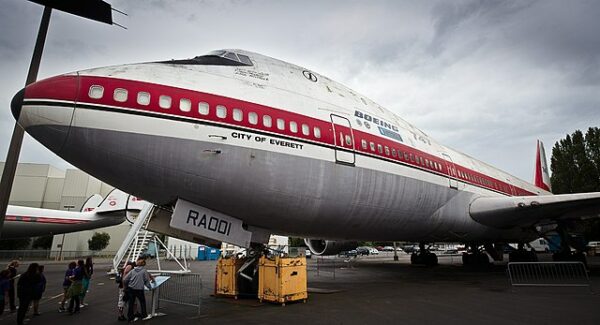
On January 22, 1970, a new era of flight quietly but decisively began as a Boeing 747 lifted off from John F. Kennedy International Airport, bound for London Heathrow Airport. Operated by its launch customer, Pan American World Airways, the world’s first “jumbo jet” entered commercial service not with fanfare alone, but with the unmistakable sense that air travel had crossed a threshold from elite experience to mass infrastructure.
The aircraft itself embodied excess by the standards of its time. With its distinctive hump-backed upper deck, four engines, and unprecedented passenger capacity, the 747 dwarfed everything that had come before it. Where earlier jetliners like the Boeing 707 had shrunk oceans for business travelers and diplomats, the 747 promised to democratize the skies. Its sheer scale signaled a future in which international travel would no longer be the preserve of the wealthy few, but a routine expectation of modern life.
That ambition was inseparable from Pan American World Airways, the airline that more than any other had come to define American aviation power in the postwar era. Pan Am founder Juan Trippe had long pressed aircraft manufacturers to think bigger—literally. His belief was simple and radical: if planes could carry far more passengers, ticket prices would fall, and global travel would expand dramatically. The 747 was the fulfillment of that vision, a flying argument for scale as destiny.
The maiden commercial flight did not unfold without friction. A minor mechanical issue delayed departure, an early reminder that aviation revolutions are rarely smooth. Yet once airborne, the symbolism was unmistakable. Passengers were not merely crossing the Atlantic; they were participating in a technological and cultural shift. The cabin itself reinforced the sense of novelty—wide aisles, spacious seating, and even a spiral staircase leading to the upper deck lounge, an indulgence that felt closer to ocean liner travel than to the cramped aircraft many travelers remembered.
The timing of the 747’s debut mattered. The late 1960s had been marked by optimism about technology’s capacity to reshape daily life, from spaceflight to computing. The jumbo jet fit squarely within that worldview. It suggested that distance itself was becoming obsolete, that the world’s major cities were being drawn into a single, tightly connected system. New York to London, once a journey measured in days and exhaustion, was now a routine overnight crossing aboard an aircraft large enough to feel almost architectural.
Yet the 747 was also a gamble—financial, industrial, and strategic. Boeing had staked its future on the aircraft, building massive new factories and betting that airlines would commit to unprecedented capacity. For Pan Am, the investment was equally bold. The airline ordered dozens of the jets, reshaping its fleet around an aircraft that required high passenger volumes to be profitable. The success of the maiden flight did not guarantee long-term victory, but it made retreat impossible.

Over time, the impact of that January flight would ripple far beyond Pan Am or Boeing. Airports were redesigned to accommodate widebody jets. Tourism exploded as transatlantic fares dropped. Global business accelerated. Even migration patterns shifted, subtly but permanently, as distance lost some of its power as a barrier.
Half a century later, the first Pan Am 747 flight stands as more than an aviation milestone. It marks the moment when air travel fully embraced mass scale. On that winter day in 1970, as the jumbo jet touched down at Heathrow, the modern, interconnected world arrived with it, four engines humming, impossibly large, and pointing unmistakably toward the future.