
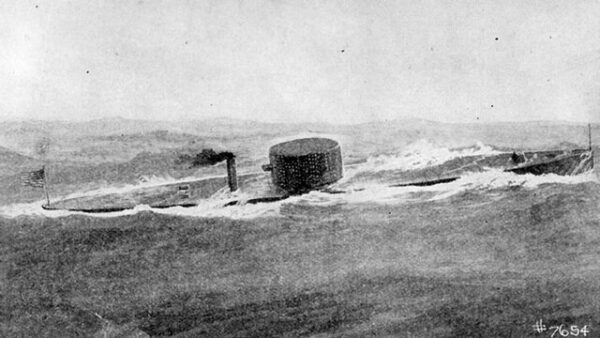
On January 30, 1862, in the depths of the American Civil War, a vessel unlike any the world had ever seen slid into the waters of New York Harbor. The USS Monitor, squat, low-slung, and almost unsettling in appearance, marked a decisive break with centuries of naval tradition. Its launch did more than introduce the United States Navy’s first ironclad warship—it announced the end of the age of wooden fleets and the beginning of modern naval warfare.
The Monitor was born of desperation and innovation. By late 1861, Union officials had learned that the Confederacy was converting the burned hulk of the USS Merrimack into an armored ironclad, later renamed the CSS Virginia. If successful, such a ship could shatter the Union blockade and dominate coastal waters. Facing this threat, the Navy issued an urgent call for ironclad designs. Among the proposals, one stood out for its radical simplicity: a nearly flat deck, a revolving gun turret, and armor thick enough to repel enemy fire.
That design came from John Ericsson, a brilliant but stubborn Swedish-American engineer whose ideas had often clashed with naval orthodoxy. Ericsson envisioned a ship that would present almost no target above the waterline. “You cannot hit what you cannot see,” he believed—and the Monitor embodied that philosophy. Its freeboard rose barely a foot above the surface, giving it the look of what one skeptical observer called a “cheesebox on a raft.”
Construction moved at a breathtaking pace. Built at the Continental Iron Works in Greenpoint, Brooklyn, the Monitor took just over 100 days from contract to launch—an extraordinary feat even by wartime standards. On January 30, workers and officials watched as the strange iron vessel entered the East River. Many doubted it would even float, let alone fight. The ship’s low profile and heavy armor made it notoriously unstable in rough seas, and its crew would later joke that it was “not a ship, but a diving bell.”
Yet the Monitor’s true genius lay in its turret. Unlike traditional warships, which mounted rows of cannons along their sides, the Monitor carried just two powerful Dahlgren guns housed in a single, rotating iron cylinder. This allowed the ship to fire in any direction without turning its hull—a revolutionary concept that would become standard in naval design for generations.
The Monitor barely had time to complete sea trials before being rushed south. In early March 1862, it arrived in Virginia just in time to confront the Confederate ironclad Virginia in what became the Battle of Hampton Roads. The previous day, the Virginia had devastated Union wooden ships, proving that traditional fleets were suddenly obsolete. When the two ironclads met on March 9, their duel ended in a tactical draw—but strategically, the outcome was unmistakable. Neither ship could seriously damage the other, and the age of wooden warships was effectively over.

News of the engagement raced across the Atlantic. European navies, long confident in their massive wooden fleets, immediately reassessed their doctrines. Within a decade, ironclads—and later steel battleships—would dominate the seas. The Monitor’s influence extended far beyond the Civil War, reshaping naval architecture worldwide.
The Monitor itself had a short and tragic career. Later in 1862, it sank in a storm off Cape Hatteras, taking sixteen crewmen with it. But its legacy endured. The name “Monitor” became synonymous with an entire class of warships, and its design principles—armor, steam power, rotating turrets—became foundational to modern naval combat.