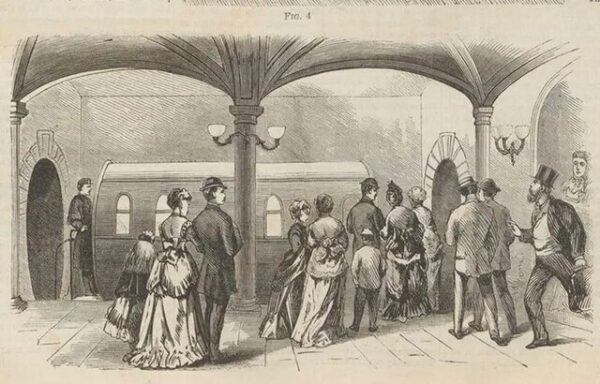
On February 26, 1870, New Yorkers descended a staircase near Broadway and Warren Street and stepped into the future.
Beneath the clatter of horse-drawn omnibuses and the mud-churned chaos of lower Manhattan, a sleek cylindrical car waited inside a brick-lined tunnel. It did not belch smoke. It did not rely on horses. Instead, it moved by air—compressed, forced, engineered. The project was called the Beach Pneumatic Transit, and though it stretched just 312 feet, it represented something far larger: a rebuke to urban paralysis and a bold argument that New York’s destiny lay underground.
The man behind it was Alfred Ely Beach, inventor and publisher of Scientific American. By the late 1860s, Manhattan’s streets were choking on their own success. Population growth, commercial expansion, and industrial energy had overwhelmed the city’s infrastructure. Elevated railroads were being proposed, but they were noisy, unsightly, and politically fraught. Beach offered a different vision—one that would preserve the city’s skyline while transforming how its citizens moved.
His solution was audacious. Using a legal permit ostensibly granted for a small mail-delivery tube, Beach quietly began digging beneath Broadway in 1869. The construction was executed with precision. Workers tunneled below the busy thoroughfare without halting traffic above, lining the passage with brick and iron supports. What emerged was not a crude experimental shaft but a polished demonstration.
When it opened on February 26, 1870, the station itself astonished visitors. Far from industrial grime, riders encountered chandeliers, upholstered seating, even a small fountain. A piano reportedly entertained guests as they awaited departure. It was part engineering exhibit, part civic theater—an effort to show skeptical lawmakers and financiers that underground transit could be safe, dignified, and even elegant.
The passenger car held roughly 20 to 22 people and ran along a narrow-gauge track. At one end of the tunnel, a massive 100-horsepower Roots blower generated compressed air that pushed—or pulled—the car through the tube like a piston. The ride was smooth and quiet, a startling contrast to the din aboveground. For 25 cents, curious riders experienced a journey that lasted less than a minute but hinted at an entirely new urban rhythm.
Public response was enthusiastic. In its first year, the line reportedly carried more than 400,000 passengers. Crowds lined up not merely for novelty but for possibility. If such a system could function beneath one block of Broadway, why not beneath all of it? Why not uptown, downtown, across the island?
Beach’s ambitions were expansive. The demonstration was never meant to remain a novelty. He petitioned the New York State Legislature for authority to extend the pneumatic subway several miles north. He envisioned a comprehensive underground network that would free Manhattan from gridlock.
But New York in 1870 was not governed by engineers. It was governed by politics. Tammany Hall, under the formidable William “Boss” Tweed, held sway over major infrastructure decisions. Tweed favored elevated railways—projects that aligned more neatly with existing financial interests and patronage networks. Beach’s privately funded underground alternative, popular with the public but lacking political muscle, stalled in Albany.
Then came the Panic of 1873. Capital dried up. Speculative ventures collapsed. Whatever slim chance the pneumatic subway had for expansion evaporated amid economic retrenchment. By the mid-1870s, the tunnel was sealed and largely forgotten.
And yet the idea endured.

When New York finally opened its first full-scale subway line in 1904, it vindicated Beach’s core premise. The city’s future would indeed run beneath its streets. Electric trains replaced compressed air, and miles replaced blocks—but the principle was the same. Underground transit was not folly; it was a necessity in a growing city.
The Beach Pneumatic Transit never became the system its creator imagined. It remained a single, elegant block—an artifact of innovation overtaken by politics. But on that February day in 1870, New York briefly glimpsed the metropolis it would become: faster, denser, subterranean.
Sometimes history turns not on sweeping triumphs, but on demonstrations: proof that something can be done. Beneath Broadway, Alfred Ely Beach proved it.