
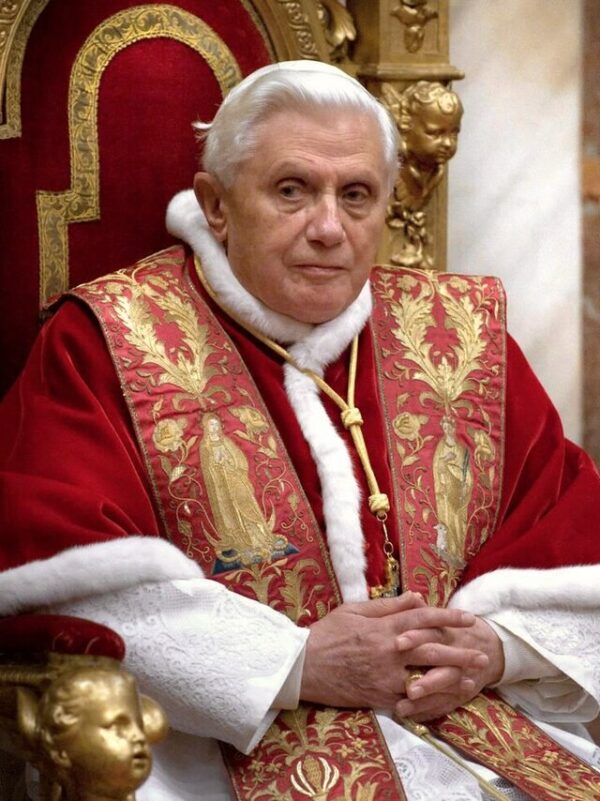
On February 28, 2013, something happened inside Vatican City that had not occurred in nearly six centuries. Pope Benedict XVI resigned the papacy—becoming the first Bishop of Rome to do so voluntarily since Pope Gregory XII stepped down in 1415 amid the wreckage of the Western Schism.
For an institution that counts its history in apostolic succession rather than election cycles, the moment was seismic.
The papacy has long carried the aura of permanence. Modern Catholics had grown accustomed to the image of the pope as a figure who endures—who suffers publicly, who declines physically, yet remains until death. The final years of Pope John Paul II reinforced that expectation: frail but steadfast, visible until his last breath. The office seemed inseparable from a lifetime vow.
Benedict quietly unsettled that assumption.
On February 11, 2013, speaking in Latin before a consistory of cardinals, he announced that he would renounce the ministry of the Bishop of Rome. At 85 years old, he said, he no longer possessed the “strength of mind and body” required to govern the Church in a world of relentless pace and mounting complexity. The modern papacy, he implied, is not merely symbolic; it is administrative, diplomatic, theological, and global. It demands stamina.
And Benedict—ever the theologian—treated the decision as a matter of conscience.
The comparison to Gregory XII is instructive. Gregory resigned under extraordinary political pressure, seeking to end a schism that had fractured Christendom with rival claimants to the throne of Peter. His abdication was an act of institutional triage. Benedict’s resignation, by contrast, occurred during structural stability. There was no rival pope, no formal schism. Instead, there was a Church navigating the lingering trauma of clergy abuse scandals, internal Vatican dysfunction exposed in the “Vatileaks” affair, and the mounting administrative burdens of a billion-member global communion.
He did not present himself as a victim of those forces. He presented himself as insufficient to meet them indefinitely.
When the clock struck 8:00 p.m. Rome time on February 28, the Apostolic Palace was sealed. The Swiss Guard withdrew. The See of Rome entered sede vacante. The machinery of succession moved forward with methodical calm. The world, meanwhile, struggled to process what had just happened: a pope had chosen to step aside.
In March 2013, the College of Cardinals elected Pope Francis as Benedict’s successor. The contrast in style and emphasis was immediate and widely remarked upon. Yet the deeper structural shift had already occurred. Benedict assumed the unprecedented title “Pope Emeritus,” retaining white cassock but relinquishing authority. For nearly a decade, two men in white lived within Vatican walls—one reigning, one retired. History had not provided a clear script for such an arrangement.

Theologically, Benedict’s move reopened a dormant question: Is the papacy sacramental in character, or juridical in function? If it is primarily an office of governance entrusted to a man, then it can be relinquished. If it is understood more mystically—as a lifelong paternal bond—resignation feels almost unnatural. Benedict resolved the tension by emphasizing the ministry rather than the mystique. The Petrine office, he suggested, is service. And service requires capacity.
His final general audience on February 27 was not defiant. It was reflective. He spoke of “joy and light,” but also of “turbulent seas.” The Church, he insisted, belongs not to any pope but to Christ. Leadership passes; the institution endures.
February 28, 2013 thus stands as a hinge point in modern Catholic history—not because doctrine changed, nor because the Church fractured, but because an ancient assumption quietly gave way. Benedict XVI did not cling to office. He relinquished it.