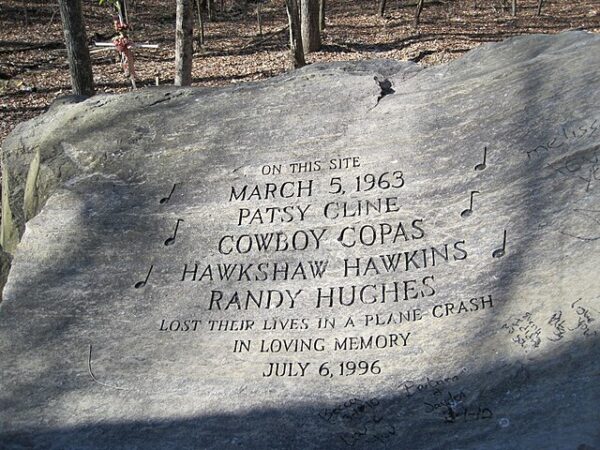
On the evening of March 5, 1963, country music lost three of its brightest voices in a tragedy that stunned the industry and sent shockwaves through the American South. A small Piper PA-24 Comanche aircraft carrying three celebrated performers—Patsy Cline, Hawkshaw Hawkins, and Cowboy Copas—along with their pilot and manager Randy Hughes crashed in a wooded area near Camden, Tennessee. All four aboard were killed.
The accident ended the life of Patsy Cline at just thirty years old, a singer widely regarded as one of the most powerful and expressive voices country music had ever produced. By 1963, Cline had already crossed the boundaries between country and pop, helping reshape the sound and commercial reach of Nashville itself.
Born Virginia Patterson Hensley in Winchester, Virginia, Cline rose to national prominence after appearing on the television program Arthur Godfrey’s Talent Scouts in 1957, where her performance of “Walkin’ After Midnight” vaulted her into the national spotlight. The song became a major crossover hit, climbing both the country and pop charts and establishing Cline as one of the emerging stars of the so-called “Nashville Sound.”
Unlike many country performers of the era, Cline’s appeal extended well beyond traditional audiences. Her rich contralto voice and emotional delivery allowed her to interpret heartbreak with unusual depth. Songs such as “I Fall to Pieces,” “Crazy,” and “She’s Got You” became defining recordings of the early 1960s. Written by Willie Nelson, “Crazy” in particular would later become one of the most frequently played songs in jukebox history.
Cline’s influence extended beyond her recordings. In a male-dominated industry, she became a mentor to younger female performers and an early symbol of country music’s growing mainstream legitimacy. By the early 1960s she was headlining tours, appearing regularly on national television, and selling records to audiences that stretched far beyond the South.
The final trip that ended her life began with a charity concert in Kansas City, Kansas. Cline, Hawkins, and Copas had performed at a benefit for the family of a disc jockey who had died in a car accident. When the concert ended, they boarded Hughes’s private plane for the return journey to Nashville.
Bad weather quickly complicated the flight. The aircraft made several stops along the way—including in Missouri and Arkansas—to wait out storms and refuel. By the afternoon of March 5, however, Hughes decided to attempt the final leg of the trip from Dyersburg, Tennessee, to Nashville.
Shortly after taking off, the small plane encountered severe weather and low visibility. At approximately 6:20 p.m., it crashed into a forested area outside Camden, about ninety miles west of Nashville. Local residents reported hearing the aircraft before the impact, but rescue crews arriving on the scene found no survivors.
News of the crash spread rapidly through Nashville and the broader country music world. For many fans, the loss felt almost unimaginable. Patsy Cline had been one of the genre’s fastest-rising stars; Hawkshaw Hawkins, a member of the Grand Ole Opry, was known for hits such as “Lonesome 7-7203”; and Cowboy Copas had been a country chart fixture since the 1940s.

The tragedy also echoed another devastating moment in American music history. Just four years earlier, a plane crash in Iowa had killed Buddy Holly, Ritchie Valens, and the Big Bopper—an event later remembered as “the day the music died.” Now country music faced its own moment of grief.
In the years that followed, Patsy Cline’s reputation only grew. Her recordings continued to sell, her voice remained instantly recognizable, and her influence shaped generations of singers who followed. In 1973, she became the first female solo artist inducted into the Country Music Hall of Fame.
The wooded hillside near Camden where the plane went down eventually became a memorial site. Today, fans still visit the quiet Tennessee clearing, leaving flowers and handwritten notes—small reminders that the music, unlike the flight that carried it, never truly stopped.