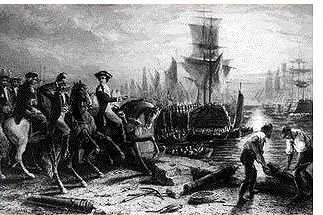
On the morning of March 17, 1776, the people of Boston watched a sight that would have seemed impossible only months earlier: the most powerful army in the world quietly abandoning the city it had occupied since the opening shots of rebellion. Red-coated soldiers boarded ships in Boston Harbor, their departure marking the end of the eleven-month Siege of Boston and delivering the young American cause its first major strategic victory.
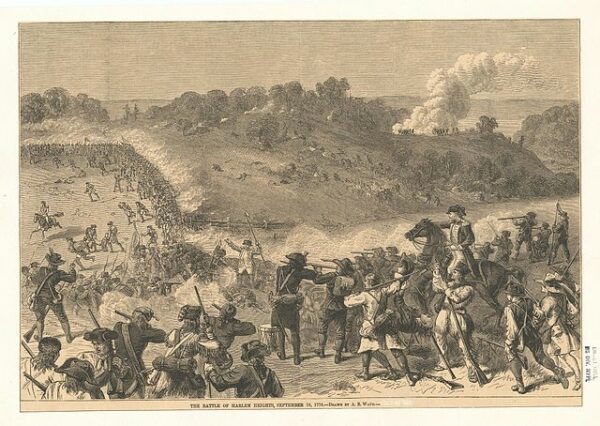
The road to that moment had begun in the chaos of April 1775, when fighting erupted at Lexington and Concord. British troops withdrew to Boston, where they soon found themselves surrounded by thousands of colonial militiamen. What followed was not a traditional siege in the European sense but a tense stalemate. The Americans lacked the artillery needed to drive the British from their fortified positions, while the British—isolated on the narrow Boston peninsula—lacked the manpower to break out and crush the rebellion once and for all.
Into this uneasy balance stepped George Washington.
Washington arrived in July 1775 to take command of what was then a loose collection of provincial militias. The army he inherited was brave but undisciplined, poorly supplied, and chronically short of gunpowder. Washington immediately recognized that forcing the British out of Boston would require more than enthusiasm and numbers. It would require artillery.
The guns, however, were hundreds of miles away.
In the autumn of 1775, Washington turned to a young and ambitious officer named Henry Knox, a former Boston bookseller with a passion for artillery. Knox proposed an audacious solution: haul the heavy cannon captured from the British at Fort Ticonderoga all the way to Boston.
The task bordered on the impossible.
Beginning in December, Knox and a small team dragged more than fifty cannon, mortars, and howitzers across nearly 300 miles of frozen wilderness. The expedition crossed the Hudson River, climbed the Berkshire Mountains, and moved slowly through snow and ice with the help of oxen and sledges. At times the artillery nearly slipped through the ice of frozen rivers. At other moments the mountain roads threatened to halt the entire operation. Yet Knox persisted. By January 1776, the cannon began arriving outside Boston.
The opportunity Washington had been waiting for had finally arrived.
During the night of March 4, 1776, American troops quietly moved the artillery onto Dorchester Heights, the high ground south of the city that overlooked both Boston and the harbor. In a remarkable feat of military engineering, soldiers worked through the darkness hauling cannon into place while constructing fortifications from timber, barrels, and packed earth.
When the sun rose the next morning, British commanders could scarcely believe what they saw.
The heights above the city bristled with American artillery.
From that vantage point Washington’s guns could rain destruction upon Boston and threaten the British fleet anchored in the harbor. General William Howe, commanding the British forces, initially planned a desperate assault to retake the heights. Yet a violent storm intervened, delaying the attack. By the time the weather cleared, Howe concluded that the position was simply too strong.
Boston was no longer defensible.

Rather than risk catastrophic losses, Howe chose evacuation. Over the next two weeks British troops prepared to leave the city they had held since the spring of 1775. On March 17, more than 9,000 soldiers—along with loyalists who feared retaliation—sailed out of Boston Harbor under the protection of the Royal Navy.
Washington’s army marched into the city the same day.
The victory was more than symbolic. For the first time since the war began, the Continental Army had forced the British to abandon a major position. The triumph boosted morale across the colonies and demonstrated that the rebels, properly organized and led, could challenge Britain’s professional army.
Equally important, the episode revealed Washington’s emerging strengths as a commander. He showed patience when a reckless assault might have led to disaster, imagination in recognizing the strategic value of Dorchester Heights, and trust in subordinates like Knox who were willing to attempt the extraordinary.
The evacuation of Boston did not end the war. In fact, far greater struggles lay ahead—in New York, New Jersey, and eventually at Yorktown. But the events of March 1776 offered a powerful glimpse of what the revolutionaries might achieve.