

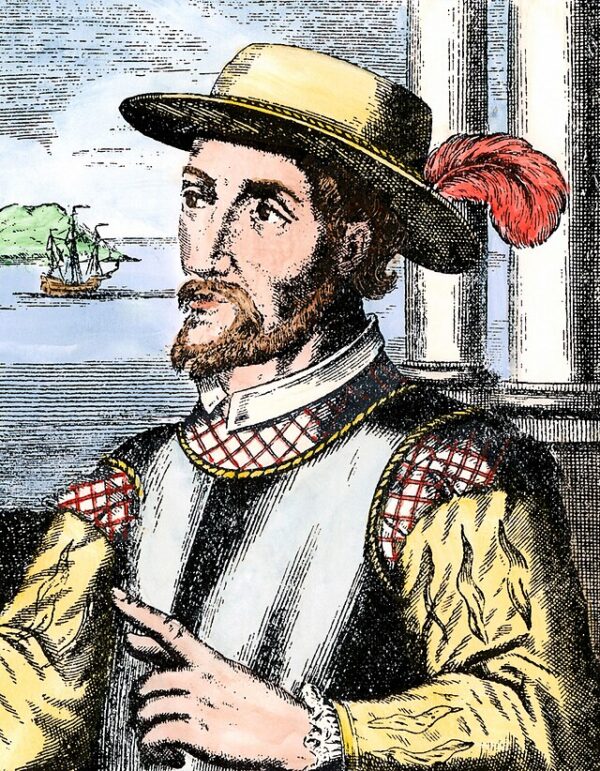
In the early spring of 1513, after weeks of sailing through uncertain waters, Spanish explorer Juan Ponce de León sighted land that would mark one of the earliest recorded European encounters with what is now the continental United States. On March 27, his expedition first glimpsed the coastline. A few days later, on April 2, he went ashore—likely somewhere between the site of present-day St. Augustine and the mouth of the St. Johns River—claiming the territory for Spain.
Ponce de León was no stranger to exploration or ambition. A veteran of Spain’s Caribbean ventures, he had previously served as governor of Puerto Rico before political disputes cost him that post. Like many Spanish explorers of the era, he sought both wealth and status, driven by reports of lands to the northwest that might yield gold, fertile territory, or strategic advantage for the Spanish crown.
His voyage in 1513 was officially authorized by King Ferdinand, granting him permission to explore and claim new lands beyond the known Caribbean islands. Setting out from Puerto Rico in March, Ponce de León commanded a small fleet of three ships. The journey was marked by strong currents—likely the Gulf Stream—that pushed his vessels northward more rapidly than expected, delivering them to an unfamiliar coastline.
When he landed on April 2, Ponce de León named the region “La Florida.” The name carried a dual meaning. It referred both to the lush, verdant landscape he encountered and to the timing of the discovery, which coincided with the Spanish Easter season known as “Pascua Florida,” or “Feast of Flowers.” The designation would endure, eventually becoming the name of the modern U.S. state.
The landing itself was not a large-scale settlement but rather a ceremonial act of possession. As was customary, Ponce de León claimed the land in the name of Spain, likely erecting a cross and conducting formal declarations of sovereignty. There is no evidence that he established a permanent colony during this expedition, nor that he ventured far inland. Instead, the voyage functioned primarily as a reconnaissance mission, mapping the coastline and identifying potential harbors.
The expedition also brought Ponce de León into contact—direct or indirect—with the Indigenous peoples of the region. While early accounts are limited and often filtered through Spanish perspectives, it is clear that Florida was already home to complex and established societies. Later Spanish attempts to settle the area would face resistance, underscoring that this was not an empty land waiting to be claimed, but one already inhabited and defended.

Over time, Ponce de León’s 1513 landing would become surrounded by legend, most famously the story that he was searching for a “Fountain of Youth.” Modern historians generally regard this tale as a later embellishment, popularized decades after his death. Contemporary records suggest his motivations were far more practical: expansion, wealth, and royal favor.
Though he did not establish a lasting settlement, Ponce de León’s expedition marked a turning point. It extended Spain’s geographic awareness northward and laid the groundwork for future exploration and colonization efforts in North America. More than half a century later, in 1565, Spanish settlers would found St. Augustine, which remains the oldest continuously inhabited European-established city in the continental United States.