

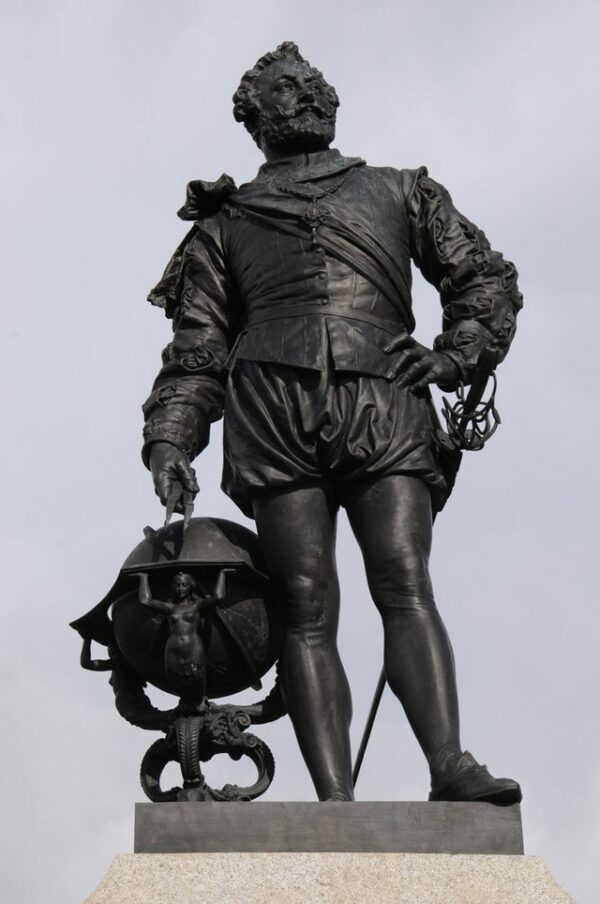
On April 4, 1581, aboard the deck of the Golden Hind at Deptford, Queen Elizabeth I conferred knighthood upon Francis Drake, elevating a once-obscure mariner into a symbol of England’s rising power on the global stage. The ceremony marked not merely a personal honor, but a calculated political statement—one that signaled England’s defiance of Spanish dominance and its arrival as a serious maritime competitor.
Drake’s knighting came at the culmination of a daring and lucrative expedition that had begun nearly three years earlier. In December 1577, he departed Plymouth with a small fleet under the nominal authority of the English crown, though the voyage’s true purpose was only thinly veiled. England and Spain were not formally at war, but tensions simmered beneath the surface. Drake’s mission—part exploration, part sanctioned piracy—was to strike at Spanish interests in the Pacific, a region Spain considered its exclusive domain.
The journey itself was perilous from the outset. Storms scattered Drake’s fleet as it navigated the treacherous waters of the Strait of Magellan, leaving only the Golden Hind to continue into the Pacific. From there, Drake sailed north along the western coast of South America, raiding Spanish ports and seizing treasure-laden ships. His most famous capture, the Nuestra Señora de la Concepción—known among English sailors as the “Cacafuego”—yielded an immense haul of silver, gold, and jewels, transforming the expedition into one of the most profitable ventures in English history.
Yet Drake’s voyage was more than a string of raids. After reaching as far north as present-day California—where he claimed the land for England, naming it “Nova Albion”—he made the fateful decision to continue westward across the Pacific rather than risk retracing his route through Spanish-controlled waters. In doing so, Drake completed only the second circumnavigation of the globe in recorded history, following the earlier expedition led by Ferdinand Magellan, though Magellan himself had not survived the journey.
The global scope of Drake’s voyage carried profound implications. It demonstrated that English ships could operate far beyond European waters, challenging Iberian claims to monopoly over the world’s oceans. It also provided valuable intelligence about trade routes, winds, and foreign defenses—information that would prove critical in the decades to come.
By the time Drake returned to England in September 1580, his ship laden with treasure, he was already a national hero. The wealth he delivered to the crown reportedly yielded a return so vast that it significantly bolstered England’s finances, helping to stabilize the monarchy at a time of persistent fiscal strain. For Elizabeth, honoring Drake was as much about rewarding success as it was about endorsing a strategy: the use of privateers to weaken Spain without committing to open war.
The knighting ceremony itself carried layers of symbolism. By conducting it aboard the Golden Hind, Elizabeth underscored the maritime nature of Drake’s achievement and England’s growing identity as a seafaring nation. According to tradition, she used a sword reportedly borrowed from the French ambassador—an additional gesture, perhaps, toward the complex web of European rivalries in which England was entangled.
Spain, for its part, viewed Drake not as a hero but as a pirate. King Philip II had already placed a bounty on his head, and the knighthood only deepened the affront. What England celebrated as bold enterprise, Spain condemned as criminal aggression. The divide foreshadowed the open conflict that would erupt later in the decade, culminating in the failed Spanish Armada of 1588—a campaign in which Drake would again play a central role.

In retrospect, the events of April 4, 1581, represented a turning point. Drake’s elevation signaled a shift in England’s posture from a peripheral European kingdom to an emerging maritime power willing to contest Spain’s global supremacy. It also cemented the model of state-backed privateering that would define much of England’s naval strategy in the Elizabethan era.
For Drake himself, the honor marked the peak of a career built on audacity, navigation, and opportunism. But for England, it marked something larger: the beginning of a new chapter in which the oceans were no longer barriers, but avenues of ambition.