
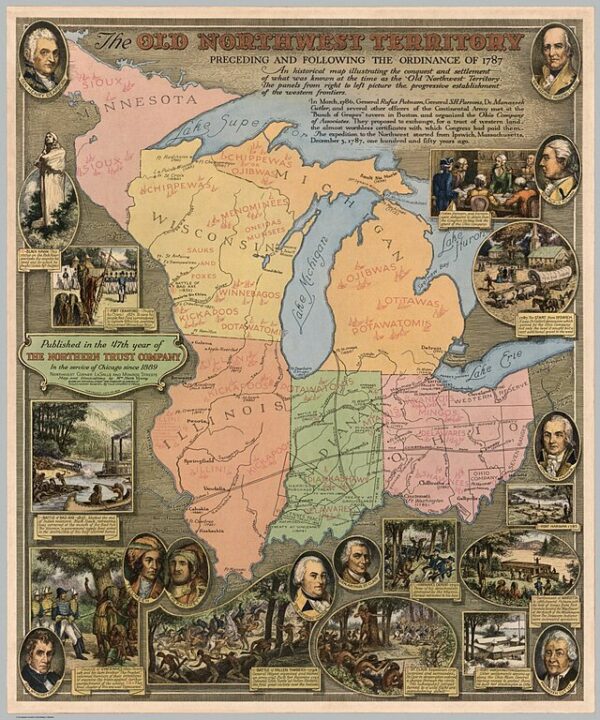
On April 7, 1788, a small band of settlers arrived at the confluence of the Ohio and Muskingum Rivers and began laying out what would become Marietta, the first permanent settlement established by American citizens in the newly organized Northwest Territory. Their landing marked more than the founding of a frontier town. It represented the opening act of the United States’ westward expansion under a new constitutional order—an attempt to translate revolutionary ideals into durable institutions beyond the Appalachian Mountains.
The settlers, many of them veterans of the Revolutionary War, had traveled under the auspices of the Ohio Company of Associates, a private land development venture formed to organize migration into the western lands ceded to the federal government after independence. These men carried with them not only tools and supplies, but also a sense of purpose. They intended to build a community that reflected the principles for which they had fought: ordered liberty, property rights, and self-government.
Their destination had been made possible by the Northwest Ordinance of 1787, one of the most consequential pieces of legislation passed under the Articles of Confederation. The ordinance established a framework for governing the Northwest Territory, outlining how new territories could transition into states on equal footing with the original thirteen. It also prohibited slavery in the region and guaranteed certain civil liberties, including trial by jury and freedom of religion. In doing so, it provided a blueprint for expansion that sought to avoid the colonial inequalities that had fueled the Revolution itself.
When the settlers arrived, they named their new town Marietta, in honor of Marie Antoinette, a symbolic nod to French support during the war. The gesture reflected a broader sense of gratitude and international awareness, even on the edge of what was then considered the American wilderness.
The early days were marked by both ambition and vulnerability. The settlers quickly constructed basic shelters and defensive works, most notably Campus Martius, a fortified enclosure designed to protect against potential attacks. Relations with Native American tribes in the region were tense, and the settlement existed within a contested landscape where sovereignty remained unresolved. The Northwest Territory was not an empty frontier, but a region inhabited by Indigenous peoples who viewed the influx of American settlers with understandable alarm.
Yet Marietta’s founders envisioned more than mere survival. From the outset, they planned a structured community, with surveyed plots, civic institutions, and an emphasis on education. Among their earliest priorities was the establishment of schools and the encouragement of intellectual life. This aspiration would later culminate in the founding of Ohio University, one of the first institutions of higher education in the territory, itself a direct outgrowth of the Northwest Ordinance’s provisions reserving land for public schooling.
The settlement also became a testing ground for federal authority. The arrival of Arthur St. Clair, appointed as governor of the territory, underscored the national government’s role in overseeing western development. Unlike earlier colonial ventures, Marietta was not an isolated outpost operating beyond the reach of centralized power. It was part of a deliberate effort to impose order on expansion, to ensure that new communities would be integrated into a coherent political system.

In this sense, Marietta stood at the intersection of idealism and pragmatism. The settlers sought to create a model society, guided by republican virtue, yet they also confronted the realities of frontier life—scarcity, insecurity, and conflict. Their experience illustrated both the promise and the limits of early American expansion. The legal framework of the Northwest Ordinance provided structure, but it could not eliminate the tensions inherent in settling contested land.
Over time, Marietta would grow into a stable and prosperous community, serving as a gateway to the Ohio Valley and a symbol of the nation’s westward trajectory.