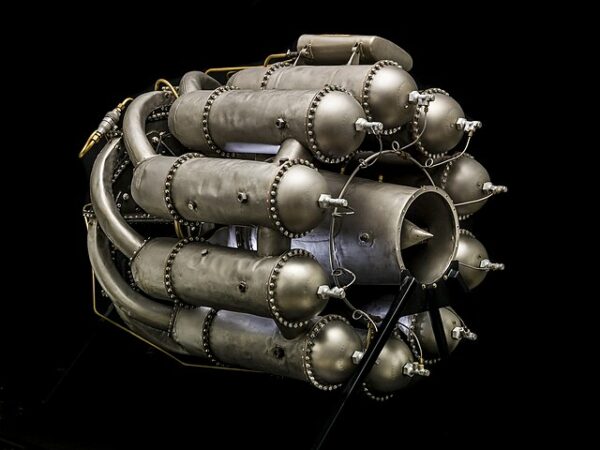
On April 12, 1937, in Rugby, England, a machine roared to life that marked the beginning of a new age in aviation. On that day, Sir Frank Whittle ground-tested the first jet engine designed specifically to power an aircraft. It was not yet a flight, not yet a public triumph, and not yet the dawn of the jet age in the full sense. But it was the decisive proof that Whittle’s long-dismissed idea could work outside theory. In a workshop, under controlled conditions, the future of flight announced itself.
Whittle was still a young Royal Air Force officer when he first began developing the concept that would make him famous. In 1930, he patented a design for a turbojet engine, proposing that aircraft could be propelled not by piston engines turning propellers, but by a continuous stream of compressed air mixed with fuel and expelled at high speed. The concept promised much greater speeds at high altitudes, where propeller-driven aircraft faced inherent limitations. Yet the idea was so far ahead of the technology and assumptions of the day that few in Britain’s military or industrial establishment treated it seriously.
That early skepticism mattered. Britain in the interwar years was not especially eager to pour money into risky experimental programs, particularly ones that seemed speculative and expensive. Conventional piston aircraft still dominated aviation, and most officials saw little reason to gamble on a radical alternative. Whittle struggled for years to secure backing. His proposal was not merely ignored; it was often treated as impractical, a vision more interesting on paper than in metal.
Still, Whittle persisted. In 1936 he and a small group of supporters formed Power Jets Ltd., the company created to turn his ideas into an operating engine. The resources at hand were limited, and the work was grueling. This was not the product of a vast government bureaucracy or a major industrial combine moving with smooth efficiency. It was a high-risk engineering effort carried forward by determination, improvisation, and the stubborn conviction that aviation’s future could not be built by simply refining existing technology.
The April 12, 1937, test at Rugby was therefore a vindication as much as a mechanical event. Conducted on the ground rather than in an aircraft, the test demonstrated that Whittle’s engine could generate sustained thrust in practice. That distinction matters. New technologies often exist first as patent drawings, calculations, and promises. What separates the merely imaginable from the historically significant is the moment when an invention begins to function reliably in the real world. Whittle’s engine had crossed that line.
The importance of the test also lay in timing. Europe in 1937 was moving toward war, though not all policymakers yet grasped how close that danger had become. Military aviation was advancing rapidly, and the powers that would soon fight the Second World War were already thinking hard about speed, altitude, and industrial capacity. Whittle’s jet engine did not immediately transform the RAF, nor did Britain instantly capitalize on the breakthrough with the urgency hindsight might suggest. But the test established a technological path that would become impossible to ignore.

In the years that followed, jet propulsion would reshape warfare and then civilian travel. During World War II, both Britain and Germany advanced jet aircraft programs, though too late and in too limited a way to determine the conflict’s outcome. After the war, however, the jet engine revolutionized global aviation. It made commercial air travel faster, altered military strategy, shrank distances between continents, and permanently changed what human beings expected from flight.