

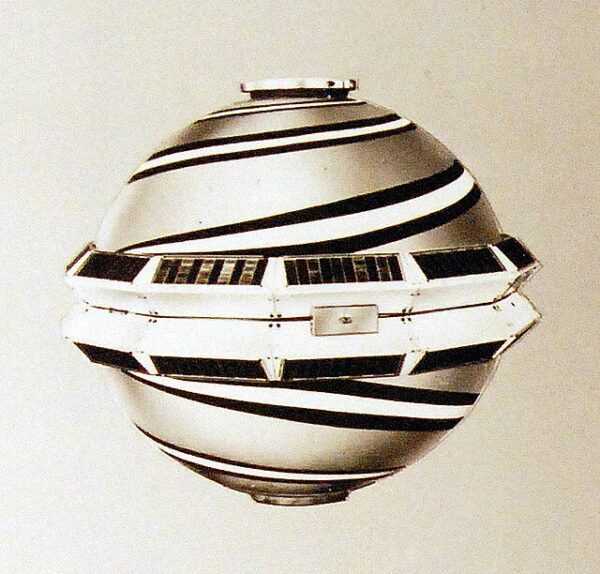
On April 13, 1960, the United States quietly entered a new era of navigation, launching the satellite known as Transit 1-B into orbit. Developed for the U.S. Navy at the height of the Cold War, the satellite marked the first successful deployment of a space-based navigation system—an innovation that would eventually reshape both military operations and civilian life.
The project emerged from a specific strategic problem. As the United States expanded its fleet of ballistic missile submarines under the Polaris missile program, accurate navigation became a matter of national survival. Submarines operating beneath the ocean’s surface needed to know their exact position before launching nuclear missiles. Traditional navigation methods—celestial fixes, dead reckoning, and inertial systems—were either too slow or insufficiently precise for the demands of modern warfare.
The answer, researchers concluded, lay in space.
The Transit system, developed by the Johns Hopkins Applied Physics Laboratory, relied on a principle that was both simple and revolutionary: the Doppler effect. By tracking changes in the frequency of radio signals transmitted from a satellite as it passed overhead, ground-based receivers could calculate their position on Earth with remarkable accuracy. The system effectively turned the satellite into a moving reference point, allowing users to determine latitude and longitude by measuring the shift in signal frequency over time.
Transit 1-B was not the first attempt. An earlier satellite, Transit 1-A, had failed to reach orbit just months before. But 1-B succeeded, entering a stable orbit and transmitting signals that confirmed the viability of the concept. Within days, engineers were able to demonstrate that the system could provide location fixes with an accuracy of roughly a few hundred meters—an extraordinary achievement for the time.
In practical terms, the system worked in intervals rather than continuously. A user would wait for a satellite pass, track its signal for several minutes, and then compute a position fix. For submarines preparing missile launches, this level of precision represented a major leap forward. It allowed the Navy to operate with a degree of confidence and independence that had previously been impossible.
The implications extended beyond the military. While Transit was initially classified and reserved for defense purposes, its success pointed to a broader transformation already underway. Navigation, long dependent on charts, compasses, and the stars, was becoming a matter of physics and computation.
By the mid-1960s, the Transit system was fully operational, with multiple satellites providing regular coverage. It was eventually made available to civilian users, including commercial shipping and scientific expeditions. Surveyors used it to map remote regions with unprecedented accuracy, while oceanographers relied on it to track the movement of vessels across vast distances.
Yet Transit’s limitations were also clear. Because it required waiting for satellite passes, it could not provide real-time, continuous positioning. Accuracy, while impressive, was still limited compared to what would later be possible. These constraints would drive the development of more advanced systems in the decades that followed.
That evolution culminated in the creation of the Global Positioning System, which began development in the 1970s and became fully operational in the 1990s. Unlike Transit, GPS offered continuous, global coverage with far greater precision, ultimately becoming a foundational technology for everything from aviation and shipping to smartphones and ride-sharing apps.

Still, the basic logic remained the same. The idea that position could be determined by signals from orbit—tested and proven with Transit 1-B—became the conceptual backbone of modern navigation.
Looking back, the launch of Transit 1-B did not carry the public drama of a moonshot or the symbolic weight of a first orbit. It was a technical achievement, largely unnoticed outside defense and scientific circles. But its consequences were enduring.
In solving a narrow military problem, the United States had opened the door to a new way of understanding location itself. What began as a Cold War tool for submarines would, over time, become an invisible infrastructure underpinning daily life—guiding ships at sea, aircraft in flight, and eventually, millions of drivers navigating city streets with a device in their pocket.