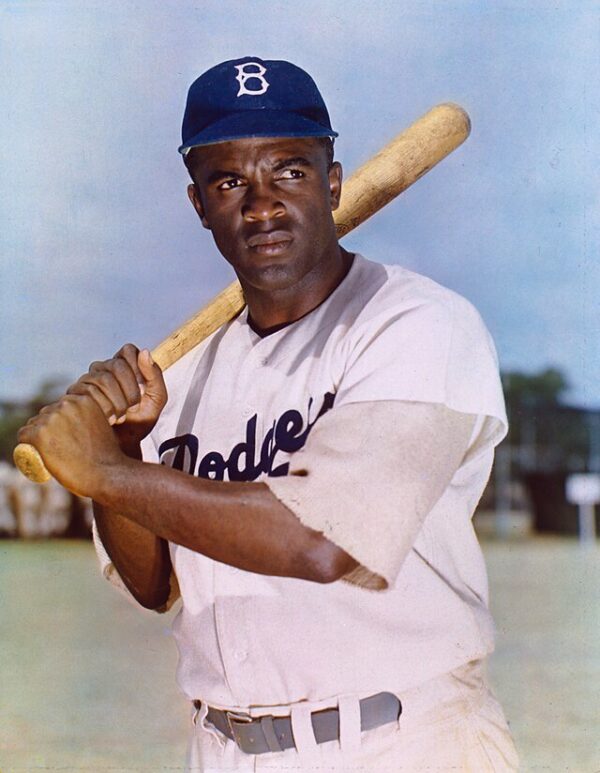
On April 18, 1946, Jackie Robinson stepped onto the field for the Montreal Royals and, in doing so, altered the trajectory of American professional sports. His regular season debut in the International League marked the first time in the modern era that a professional baseball team in organized white baseball was integrated—an event both symbolic and immediate in its consequences.
The setting was Montreal’s Delorimier Stadium, before a crowd that understood, at least in part, the significance of the moment. Robinson had been signed the previous year by the Brooklyn Dodgers organization under the direction of executive Branch Rickey, who had spent years searching for a player capable not only of excelling on the field but of withstanding the hostility that would inevitably follow. Robinson, a former multi-sport star at UCLA and a veteran of the U.S. Army, was Rickey’s answer.
The decision to assign Robinson to Montreal rather than promote him immediately to the major leagues was deliberate. The Royals, the Dodgers’ top farm club, offered a proving ground—competitive baseball paired with a city widely viewed as more tolerant than many American locales. Even so, the risks were clear. Organized baseball had been segregated for decades, enforced not by written rule but by a rigid and widely accepted custom.
Robinson wasted little time justifying Rickey’s gamble. In his debut, he reached base multiple times and electrified the crowd with aggressive baserunning, ultimately scoring runs and demonstrating the dynamic style of play that would soon define his career. Contemporary accounts describe not only his performance but the reaction it produced—curiosity giving way to admiration as the game unfolded.
The significance of the debut extended beyond the box score. Robinson’s presence on the field challenged an entrenched system that had excluded Black players from Major League Baseball since the late 19th century, confining them instead to the Negro Leagues. Integration had been discussed in abstract terms before, but Robinson’s debut forced the issue into reality. The question was no longer whether integration might occur, but whether it could succeed.
Montreal proved a crucial testing ground. Unlike the hostility Robinson would later encounter in some American cities, he was embraced by many fans in Canada. That reception mattered. It provided a counterpoint to the argument—common among opponents of integration—that fans would reject a Black player outright. Robinson’s success in Montreal undermined that claim, both statistically and visibly.
Over the course of the 1946 season, Robinson dominated the International League. He hit for average, stole bases, and played with an intensity that set him apart. More importantly, he endured the pressures Rickey had anticipated: verbal abuse from opposing players, resistance from some teammates, and the constant scrutiny of being the first to cross a long-standing racial barrier. His performance, both athletic and personal, made clear that he could withstand those pressures at the highest level.
The broader context of Robinson’s debut reflects a nation in transition. The end of World War II had exposed contradictions between America’s democratic ideals and its racial realities. Black veterans returned home having fought for freedom abroad, only to face segregation at home. In that environment, Robinson’s integration of professional baseball took on a significance that extended well beyond sport. It became, in effect, a test case for integration in American public life.

One year later, Robinson would make his major league debut with Brooklyn, formally breaking baseball’s color barrier. But that moment was built on what occurred in Montreal. April 18, 1946, was not an isolated milestone; it was the beginning of a process—one that demonstrated both the possibilities and the costs of integration.
In retrospect, Robinson’s debut with the Montreal Royals stands as a turning point not because it resolved the tensions surrounding race in America, but because it made them impossible to ignore within one of the nation’s most visible institutions. The game itself did not change overnight. But the line had been crossed, and it would not be redrawn.