
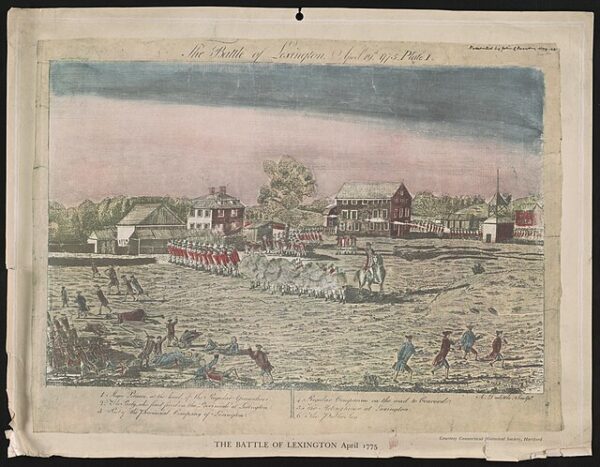
On April 19, 1775, the opening shots of the American Revolutionary War at Lexington and Concord—later immortalized as “the shot heard around the world”—gave way, almost immediately, to something more consequential than a single day’s fighting. As British regulars retreated into Boston under constant fire from colonial militia, the countryside did not simply quiet. Instead, it closed in. What began as a running battle hardened into a siege—an improvised but determined effort by New England militias to isolate British forces inside the city and challenge imperial authority in a sustained way.
Boston, already a focal point of imperial tension, now became a trapped garrison. British troops under Gen. Thomas Gage, having marched out to seize colonial military supplies and arrest rebel leaders, found themselves driven back by thousands of armed farmers and townsmen who had mobilized with striking speed. By the evening of April 19, the roads leading into Boston were no longer secure. Militia units from Massachusetts and neighboring colonies converged, occupying key positions along the narrow neck of land that connected the city to the mainland.
The geography of Boston made this possible. Surrounded by water on three sides and connected to the mainland by a thin strip known as Boston Neck, the city could be effectively cut off if that corridor were controlled. Colonial forces moved quickly to do just that. Within days, an informal but increasingly organized ring of militia encampments formed around British-held Boston, stretching from Roxbury in the south to Cambridge and beyond in the north. Their objective was not to storm the city outright—something they lacked the training and heavy weaponry to attempt—but to contain the British army, restrict its movement, and force a strategic stalemate.
What emerged was not yet a professional army, but it was no mere mob. The militias brought with them local knowledge, decentralized leadership, and a shared sense that events had passed a point of no return. Many of the men who took up positions around Boston had fought earlier that same day at Lexington or along the road from Concord. Others arrived in the following days, responding to alarm riders and word-of-mouth reports that the British had shed colonial blood. The effect was cumulative. By late April, thousands of armed colonists had effectively encircled the city.
Inside Boston, the British position was precarious. Though they retained control of the harbor and could be resupplied by sea, their ability to project power into the surrounding countryside was sharply curtailed. Any movement beyond their lines risked ambush. The experience of April 19 had demonstrated that even disciplined regulars could be harried and bloodied by irregular forces using terrain and distance to their advantage. Gage, a veteran officer, now faced an enemy that would not meet him in traditional formation but would not disperse either.
The siege that took shape was, at first, loosely coordinated. Colonial forces lacked a unified command structure, and supply conditions were uneven. Yet the strategic logic was clear: deny the British freedom of movement, wait for reinforcements and organization, and transform local resistance into something resembling a continental effort. In this sense, the Siege of Boston marked a transition point. The conflict was no longer a series of protests or isolated clashes. It had become a sustained military confrontation with defined positions and objectives.

In the weeks that followed, this encirclement would draw in leaders and resources from across the colonies. The Continental Congress, meeting in Philadelphia, began to assume a more direct role in coordinating the war effort. By June, it would appoint George Washington as commander-in-chief of a newly formed Continental Army, formalizing what had begun as a regional uprising. But that development rested on the reality established in April: that colonial forces had not only resisted British authority but had taken the initiative.
The Siege of Boston would endure for nearly a year, punctuated by moments of intense fighting, including the Battle of Bunker Hill in June 1775. Yet its origins remained rooted in the immediate aftermath of Lexington and Concord. On April 19, the British sought to assert control and instead triggered a response that closed the countryside against them. The militias did not disperse. They stayed, they organized, and, eventually, built a nation for themselves.