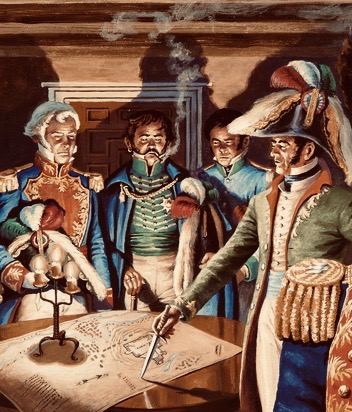
On April 22, 1836—one day after the decisive clash at the Battle of San Jacinto—the Texas Revolution reached its true turning point not in combat, but in recognition. In the chaotic aftermath of victory, forces under Sam Houston identified and captured the man who had led Mexico’s campaign to crush the rebellion: Antonio López de Santa Anna.
The battle on April 21 had unfolded with stunning speed. After weeks of strategic retreat, Houston chose his moment and launched a surprise afternoon attack on Santa Anna’s encampment along the San Jacinto River. Mexican forces, divided and unprepared, were caught off guard—many resting when the Texan army advanced, shouting “Remember the Alamo!” and “Remember Goliad!” The assault shattered organized resistance in less than twenty minutes. Mexican lines collapsed, and what began as a defensive stand turned into a rout.
Hundreds of Mexican soldiers were killed, and hundreds more were taken prisoner. Santa Anna fled during the chaos, abandoning his command in an effort to escape. Stripped of his recognizable uniform and dressed as a common soldier, he attempted to blend in with the scattered remnants of his army.
By the following morning, Texan patrols were sweeping the area, rounding up stragglers and consolidating control. Among the captured soldiers on April 22 was a weary, mud-stained figure who appeared no different from the others. For a brief time, Santa Anna’s disguise succeeded. He was detained and held with other prisoners, his identity unnoticed.
What followed was largely accidental. As the prisoners were brought before Texan guards, several Mexican soldiers reportedly reacted with visible deference to the disguised man. Some addressed him as “El Presidente,” betraying his true status. The reaction immediately raised suspicion among Texan officers, who began to question the prisoner more closely.
The realization came quickly. The man was identified as Santa Anna and brought before Houston, who had been wounded during the battle and was recovering in camp. With that recognition, the nature of the Texan victory changed instantly. The revolution’s central adversary—the general and political leader directing the campaign—was now in custody.
Santa Anna’s capture transformed a battlefield success into a decisive strategic advantage. Calls for execution were immediate, fueled by anger over earlier atrocities, including the fall of the Alamo and the massacre at Goliad. But Houston resisted. He understood that Santa Anna alive was far more valuable than Santa Anna dead.
Instead of revenge, Houston chose leverage. In the days and weeks that followed, negotiations began between Texan leaders and their captive. These discussions led to the Treaties of Velasco in May 1836. Publicly, the agreements called for the withdrawal of Mexican forces and an end to hostilities. Privately, Santa Anna agreed to terms recognizing Texas independence.

Though the Mexican government would later dispute the legitimacy of agreements signed under duress, the practical outcome was clear. Organized resistance in Texas collapsed, and the Republic of Texas emerged as an independent nation in fact, if not immediately in universal recognition.
The events of April 22 underscore how fragile and contingent history can be. The outcome of the Texas Revolution did not rest solely on the violence of San Jacinto, but on what followed—the chance recognition of a disguised prisoner, and the decision to turn that moment into political advantage.
Had Santa Anna escaped, the war might have dragged on, with uncertain consequences. Instead, a moment of inadvertent disclosure—from the words of his own soldiers—ended the campaign. In that instant, the revolution shifted from war to negotiation, and the independence of Texas moved from possibility to reality.