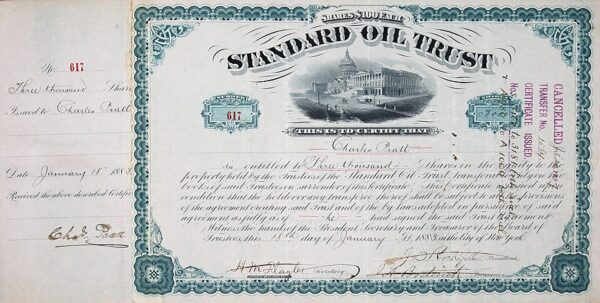
On May 15, 1911, the United States Supreme Court delivered one of the most consequential antitrust decisions in American history, ruling in Standard Oil Co. of New Jersey v. United States that John D. Rockefeller’s oil empire had violated the Sherman Antitrust Act and must be broken apart.
The decision marked a turning point in the Progressive Era’s campaign against monopoly power. For decades, Standard Oil had stood as the most famous symbol of industrial concentration in America. It had begun as a powerful refining company and grew into a sprawling corporate system that controlled much of the nation’s oil refining, transportation, marketing, and distribution. To supporters, it represented efficiency, scale, and modern business organization. To critics, it embodied the danger of private power growing so large that it could dominate markets, crush rivals, and bend the economy to its will.
The case arose under the Sherman Antitrust Act of 1890, the federal law passed to restrain monopolies and combinations that interfered with competition. The act declared illegal every contract, combination, or conspiracy “in restraint of trade” and prohibited monopolization or attempts to monopolize interstate commerce. But in the years after its passage, courts struggled to define how broadly the statute should apply. Did it outlaw every restraint of trade, even ordinary business agreements? Or only those restraints considered harmful, coercive, or excessive?
The Standard Oil case forced the Supreme Court to answer that question.
The federal government had sued Standard Oil in 1906, arguing that the company had built and maintained its dominance through a long pattern of anti-competitive conduct. Prosecutors pointed to railroad rebates, predatory pricing, secret agreements, discriminatory practices, acquisitions of rivals, and other tactics that helped Standard Oil consolidate control over the industry. The government’s argument was not merely that Standard Oil was large. It was that the company had used its size and power to restrain trade and exclude competition.
Chief Justice Edward Douglass White, writing for the Court, agreed. The Court held that Standard Oil had violated the Sherman Act by creating and maintaining an unreasonable monopoly. In doing so, the justices adopted what became known as the “rule of reason,” a doctrine that distinguished between ordinary restraints of trade and unreasonable restraints that harmed competition. This interpretation narrowed the literal wording of the Sherman Act while also giving courts a flexible standard for judging monopoly cases.
That reasoning became one of the most important features of American antitrust law. The Court did not say that all large corporations were illegal simply because they were large. Nor did it condemn every business practice that limited competition in some technical sense. Instead, it focused on whether the conduct at issue unreasonably restrained trade or produced monopoly power through improper means.
For Standard Oil, the result was decisive. The Court ordered the company to be dissolved into separate firms. The breakup produced more than 30 successor companies, including firms that later became Exxon, Mobil, Chevron, Amoco, and others. Rockefeller’s empire was dismantled as a unified trust, though its component parts remained powerful players in the energy industry.
The ruling carried significance far beyond oil. It announced that the federal government had both the authority and the will to confront the largest corporate combinations in the country. It also confirmed that antitrust enforcement would not simply be a matter of punishing size, but of examining conduct, market power, and the practical effects of business organization.
The decision came during a broader national struggle over industrial capitalism. By 1911, Americans had seen railroads, steel, oil, finance, and other industries concentrated in the hands of a small number of dominant firms. Progressives argued that such concentrations threatened democratic government, small enterprise, and fair competition. Conservatives and business defenders countered that large firms often reduced costs, stabilized production, and made modern economic growth possible.

The Standard Oil decision tried to navigate that conflict. It did not reject big business outright. But it declared that economic efficiency could not excuse unlawful monopoly practices. A corporation could grow large through skill, innovation, and legitimate competition. It could not lawfully use coercive tactics to shut rivals out of the market and preserve dominance.
More than a century later, the case remains a foundation of antitrust law and a recurring reference point in debates over corporate power. Whether the target is oil, railroads, technology, finance, or digital platforms, the central question remains close to the one the Court confronted in 1911: when does successful enterprise become unlawful monopoly?
On May 15, 1911, the Supreme Court gave one of its most enduring answers. Standard Oil had not merely won in the marketplace. It had used its power to make the marketplace less open. For that reason, the nation’s most powerful corporation was ordered to break apart.