On May 18, 1896, the United States Supreme Court handed down one of the most infamous decisions in American constitutional history. In Plessy v. Ferguson, the Court ruled that racial segregation did not violate the Constitution so long as the facilities provided to Black and white Americans were “separate but equal.”
The ruling gave constitutional cover to Jim Crow, the system of state and local laws that enforced racial separation across the South and much of the country for nearly six decades. It would not be overturned until 1954, when the Supreme Court decided Brown v. Board of Education.
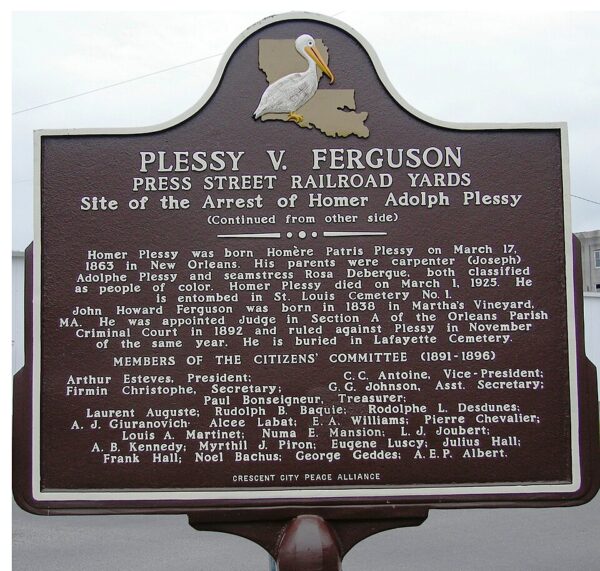
The case began in Louisiana, where lawmakers had passed the Separate Car Act in 1890. The law required railroads to provide “equal but separate” accommodations for white and Black passengers. Violators could be fined or jailed. To challenge the statute, a group of Black citizens and civil rights activists in New Orleans organized a test case.
They selected Homer Plessy, a shoemaker of mixed racial ancestry who was legally classified as Black under Louisiana law. On June 7, 1892, Plessy bought a first-class ticket on the East Louisiana Railroad and boarded a car reserved for white passengers. He announced that he was Black and refused to move to the car designated for Black passengers. He was arrested.
Plessy’s lawyers argued that the Louisiana law violated the 13th and 14th Amendments. The 13th Amendment had abolished slavery. The 14th Amendment, adopted after the Civil War, guaranteed equal protection of the laws and citizenship rights to those born or naturalized in the United States. For Plessy’s attorneys, legally enforced segregation was a badge of servitude and a denial of equal citizenship.
The Supreme Court rejected that argument in a 7-1 decision. Justice Henry Billings Brown wrote the majority opinion, concluding that the 14th Amendment was designed to establish legal equality, not to abolish social distinctions between the races. The Court held that laws requiring separation did not necessarily imply the inferiority of Black Americans.
That claim became one of the most consequential legal fictions in American history. In practice, segregation was not a neutral separation of races. It was a system of public humiliation, economic exclusion, political subordination, and state-enforced inequality. Schools, rail cars, waiting rooms, restaurants, theaters, parks, cemeteries, hospitals, and even drinking fountains were divided by race. The facilities provided to Black Americans were almost always inferior.
Justice John Marshall Harlan issued the lone dissent. A former slaveholder from Kentucky who had become a defender of civil rights, Harlan warned that the decision would become as destructive as the Court’s earlier ruling in Dred Scott v. Sandford. His dissent included one of the most famous lines in Supreme Court history: “Our Constitution is color-blind, and neither knows nor tolerates classes among citizens.”
Harlan understood what the majority refused to acknowledge. Segregation was not merely a matter of social preference. It was a legal regime designed to mark Black citizens as inferior and to preserve white dominance after Reconstruction. By pretending that separation could be equal, the Court helped dismantle the promise of the Civil War amendments.

The timing was critical. Reconstruction had ended less than 20 years earlier. Federal protection for Black civil rights had collapsed. Southern states were imposing poll taxes, literacy tests, grandfather clauses, and other devices to disenfranchise Black voters. Racial violence and lynching were used to enforce the new order outside the courtroom. Plessy gave that order a constitutional blessing.
The ruling shaped American life for generations. It allowed states to build racially segregated public school systems and helped justify a broad architecture of discrimination. Black Americans challenged that regime through journalism, litigation, protest, institution-building, and political organizing. The NAACP, founded in 1909, eventually made the legal assault on segregation one of its central missions.
In Brown v. Board of Education, the Court finally repudiated Plessy in the field of public education, declaring that “separate educational facilities are inherently unequal.” Yet the legacy of Plessy did not disappear with a single ruling. It had embedded racial inequality into law, custom, housing patterns, education, and public institutions.