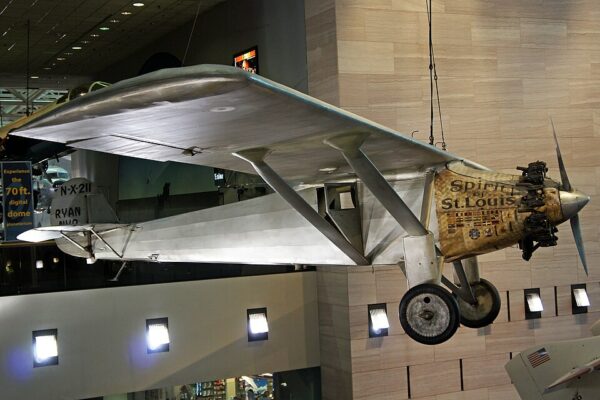
On May 21, 1927, a slight, soft-spoken American pilot named Charles Lindbergh descended out of the darkening sky over Paris and became, almost instantly, one of the most famous men in the world.
His landing at Le Bourget Field completed the first solo nonstop flight across the Atlantic Ocean, a feat that had seemed, even to many experienced aviators, nearly impossible. Lindbergh had taken off from Roosevelt Field on Long Island the previous morning in a custom-built monoplane called the Spirit of St. Louis. More than 33 hours later, after battling exhaustion, fog, ice, and the loneliness of an open ocean crossing, he reached France and entered history.
The flight was not merely a personal triumph. It was a defining moment in the young age of aviation. Airplanes had already proved their military value during World War I, and daring pilots had crossed long distances before. But the Atlantic remained a psychological barrier. To fly alone, without stopping, from New York to Paris required not only engineering skill but extraordinary nerve. The route stretched roughly 3,600 miles. Lindbergh had no radio, no parachute, and limited forward visibility because the plane’s large fuel tank was placed in front of the cockpit. He navigated with charts, instruments, dead reckoning, and instinct.
Lindbergh was only 25 years old. Before the flight, he was known mainly within aviation circles as an airmail pilot. He had flown dangerous routes through bad weather and had developed the calm, disciplined habits that long-distance flying required. But he was not the best-known contender for the Orteig Prize, the $25,000 award offered to the first aviator who could fly nonstop between New York and Paris. Wealthier and more famous pilots had tried or planned to try. Some had died in the attempt. Lindbergh’s advantage was not fame but simplicity. He believed that a single-engine plane, stripped to essentials and carrying one pilot, had the best chance of success.
The Spirit of St. Louis reflected that philosophy. Built by Ryan Airlines in San Diego, it was designed around endurance rather than comfort. Every unnecessary pound was removed. Lindbergh carried sandwiches, water, emergency supplies, and a few basic instruments, but little else. The plane was essentially a flying fuel tank with wings, built for one purpose: to stay aloft long enough to cross the ocean.
The danger became clear almost immediately. The plane was so heavy with fuel that it barely cleared telephone wires after takeoff. Once over the Atlantic, Lindbergh faced a deeper test. He had to remain awake for more than a day and a half while flying through cold, darkness, and uncertainty. At times, he flew just above the waves. At others, he climbed to avoid weather. Sleep deprivation became one of his greatest enemies. He later described struggling to stay conscious as the hours dragged on.
When he finally approached the coast of Ireland, Lindbergh knew he had done more than survive the ocean. He had kept the plane on course. From there, he crossed England and the English Channel before heading toward Paris. By the time he reached Le Bourget, word of his approach had spread. A massive crowd had gathered, far larger than officials had expected. Tens of thousands of people poured onto the field, eager to see the American who had conquered the Atlantic alone.
Lindbergh landed at 10:22 p.m. Paris time. The crowd surged toward the plane. Within moments, he was pulled from the cockpit and carried above the cheering mass. The quiet airmail pilot had become an international hero.

The flight transformed aviation’s place in public imagination. It showed that airplanes were not simply machines for war, spectacle, or daredevil stunts. They could connect continents. Lindbergh’s achievement helped accelerate public confidence in commercial aviation, encouraged investment in aircraft development, and gave the modern air age one of its foundational legends.
His later life would become far more complicated, marked by tragedy, controversy, and political misjudgment. But on May 21, 1927, the meaning of the moment was clear. A lone pilot had crossed an ocean in a fragile machine and landed in Paris before a stunned world. In doing so, Charles Lindbergh turned the Atlantic from a barrier into a route.