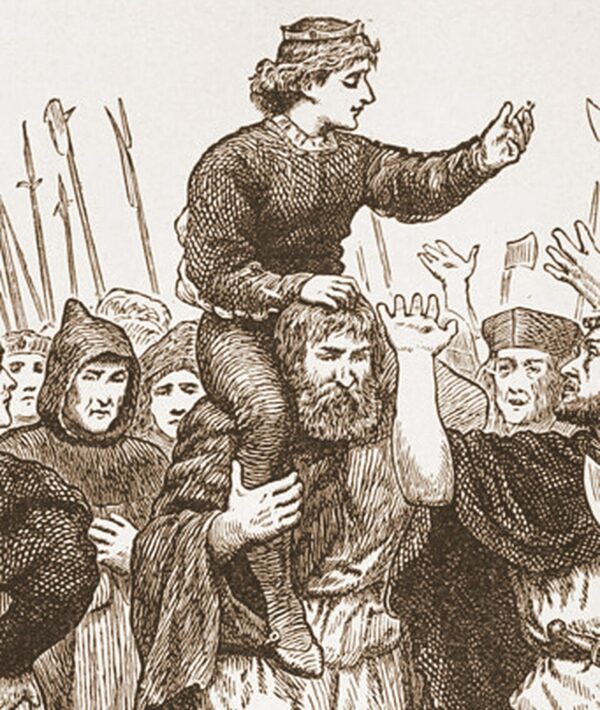
On May 24, 1487, a 10-year-old boy named Lambert Simnel was crowned in Christ Church Cathedral in Dublin, taking the name Edward VI in one of the most audacious attempts to overthrow England’s new Tudor king.
The ceremony was not a childish fantasy. It was a calculated political act by Yorkist opponents of King Henry VII, whose claim to the throne remained vulnerable less than two years after his victory over Richard III at Bosworth Field. By placing a crowned boy before the public and presenting him as a surviving Plantagenet heir, Henry’s enemies sought to turn dynastic uncertainty into open rebellion.
Simnel was the son of an Oxford tradesman, but he became useful because he could be trained to impersonate Edward Plantagenet, Earl of Warwick, the young nephew of Edward IV and Richard III. Warwick had a legitimate Yorkist bloodline and, for that reason, represented a potential threat to Henry VII. The problem for the conspirators was that the real Warwick was alive and imprisoned in the Tower of London. Henry even had him displayed publicly in London to prove that Simnel was an impostor, but the rebellion had already gained momentum.
The plot drew strength from the unsettled politics of the Wars of the Roses. Henry VII had founded the Tudor dynasty by conquest in 1485, but victory on the battlefield did not instantly confer legitimacy. Many Yorkists still regarded the Tudors as upstarts, and Ireland remained a center of Yorkist sympathy. Dublin, far from being a symbolic afterthought, was a strategic choice. The Yorkist cause had deep support there, and the local Anglo-Irish elite was willing to lend ceremony, manpower, and prestige to the challenge.
The rebellion’s leading adult figure was John de la Pole, Earl of Lincoln, a nephew of Richard III and a man with his own claim to Yorkist leadership. Francis Lovell, another Yorkist loyalist, also joined the conspiracy. Support came from abroad as well. Margaret of York, Duchess of Burgundy and sister of Edward IV, helped provide mercenaries under the command of Martin Schwartz. By the time Simnel was crowned in Dublin, the boy had become the visible face of a much more serious military project.
The coronation itself was both theatrical and political. Simnel was crowned as “King Edward VI,” a title meant to place him in the Yorkist line and deny Henry’s legitimacy. In ordinary English history, the name Edward VI would later belong to Henry VIII’s son, who reigned in the 16th century. But in 1487, the name was an insurgent claim, not an accepted reign. The crown placed on Simnel’s head in Christ Church Cathedral was meant to create a rival monarchy before a rival army crossed into England.
The rebellion soon moved from ceremony to war. The rebel force, made up largely of Irish troops and foreign mercenaries, landed in northwest England in June 1487. But the uprising failed to ignite the broad Yorkist revolt its organizers had hoped for. Many English nobles stayed loyal to Henry or remained cautious. Without widespread support, the rebels were forced into a direct military confrontation.
That confrontation came at the Battle of Stoke Field on June 16, 1487, often regarded as the final battle of the Wars of the Roses. Henry’s forces defeated the rebels decisively. Lincoln and many of the rebellion’s leaders were killed. The military threat to the Tudor regime was broken. Simnel, the child around whom the rebellion had been staged, was captured.

Henry VII’s response showed both calculation and confidence. Rather than execute the boy, he pardoned him, recognizing that Simnel had been a pawn rather than the architect of the rebellion. According to later accounts, Simnel was put to work in the royal kitchens and eventually became a falconer in the king’s service. His survival was itself a Tudor message: the dynasty could punish traitors, but it could also absorb and humiliate the symbols used against it.
The Dublin coronation of Lambert Simnel remains one of the strangest episodes of Tudor history because it combined absurdity with real danger. A child of obscure birth was briefly presented as a king, yet behind him stood aristocratic resentment, foreign money, Irish support, and the unresolved wounds of civil war. The episode revealed how fragile Henry VII’s early reign still was—and how much work the Tudors had to do before their dynasty became secure.