
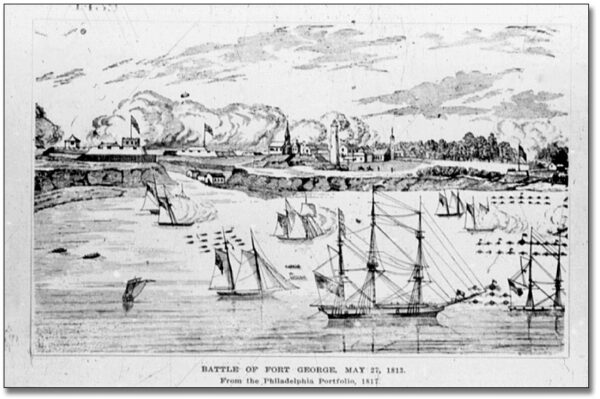
On May 27, 1813, American forces captured Fort George, a key British stronghold on the Niagara frontier, in one of the most successful U.S. operations of the War of 1812.
The victory came at a moment when the United States was trying to recover from a series of early failures in the war. American leaders had entered the conflict expecting Canada to be vulnerable to invasion, but the first year brought frustration, embarrassment, and defeat. Detroit fell to the British in 1812, and several American attempts to move into Upper Canada collapsed. By the spring of 1813, the Niagara River had become one of the central fronts in the war, and Fort George stood as one of the main British defenses guarding the western side of the river near present-day Niagara-on-the-Lake, Ontario.
The American plan called for a coordinated assault by land and water. Fort George sat across the Niagara River from Fort Niagara in New York, giving U.S. forces a base from which to bombard the British position and launch an amphibious landing. The operation was led by Maj. Gen. Henry Dearborn, with important battlefield command exercised by Brig. Gen. Winfield Scott, who helped organize and lead the landing force. The American naval effort on Lake Ontario, commanded by Commodore Isaac Chauncey, provided critical support.
Before the landing began, American guns opened a heavy bombardment from Fort Niagara and nearby batteries. Chauncey’s ships also fired on British positions along the shoreline. The bombardment damaged Fort George and helped weaken British defenses before the infantry came ashore. The goal was not merely to storm the fort directly, but to land troops west of the position, drive back the defenders, and force the British either to retreat or be trapped.
The landing itself was a dangerous operation. American troops had to cross open water under enemy fire and disembark on a defended shoreline. Scott, who would later become one of the most prominent American generals of the 19th century, played a leading role in getting the troops ashore and pressing the attack. The Americans advanced against British regulars, Canadian militia, and Native allies who tried to contest the landing and slow the U.S. push inland.
The British commander, Brig. Gen. John Vincent, faced a difficult choice. His men were outnumbered, the fort had been badly battered, and American forces were threatening his line of retreat. Rather than risk being surrounded, Vincent ordered his forces to withdraw. The British abandoned Fort George and retreated westward toward Burlington Heights, near present-day Hamilton, Ontario.
The American capture of Fort George was a major tactical success. It gave the United States control of an important British post, forced the enemy back from the Niagara River, and raised American morale after a difficult opening year of the war. For a brief period, it appeared that the United States might be able to turn the Niagara campaign into a deeper invasion of Upper Canada.

But the victory also exposed a recurring weakness in American strategy during the War of 1812: the inability to follow battlefield success with decisive exploitation. Dearborn was elderly and ill, and the American command structure lacked urgency. Instead of rapidly pursuing Vincent’s retreating force, U.S. troops moved slowly. That delay allowed the British to regroup. Just days later, on June 6, British forces struck back at the Battle of Stoney Creek, surprising an American force and halting the U.S. advance.
Fort George remained in American hands for several months, but the larger campaign failed to achieve its most ambitious goals. By December 1813, as the Americans withdrew from the Canadian side of the Niagara River, they burned the nearby town of Newark, an action that helped trigger harsh British retaliation along the frontier.