
On May 28, 1830, President Andrew Jackson signed the Indian Removal Act, one of the most consequential and destructive laws in American history.
The measure authorized the president to negotiate treaties that would exchange Native lands east of the Mississippi River for territory farther west. In practice, it became the legal foundation for forced removal, dispossession, and mass suffering. Though framed by supporters as a voluntary exchange, the law placed enormous federal pressure on Native nations to surrender ancestral homelands they had occupied for generations.
Jackson had long supported Indian removal. He argued that Native peoples could not safely coexist with expanding white settlement and claimed relocation would protect them from extinction. But the policy served a more direct purpose: opening millions of acres of Native land in the Southeast to white farmers, slaveholders, and speculators. The cotton economy was expanding rapidly, and Native land stood in the path of American settlement.
The law especially targeted the so-called Five Civilized Tribes: the Cherokee, Choctaw, Chickasaw, Creek, and Seminole nations. These communities had developed farms, schools, written laws, newspapers, and constitutional governments. The Cherokee Nation, in particular, had adopted a written constitution and pursued legal resistance through the American court system.
That resistance briefly succeeded. In Worcester v. Georgia in 1832, the U.S. Supreme Court ruled that Georgia had no authority to impose its laws inside Cherokee territory. But the ruling did not stop removal. Jackson’s administration refused to defend Cherokee sovereignty, and Georgia continued pressing for Native land.
The results were devastating. The Choctaw were among the first forced westward, beginning in 1831. Thousands suffered from hunger, disease, exposure, and exhaustion. The Creek and Chickasaw were also driven from their lands. The Seminole resisted in Florida, leading to years of costly war.
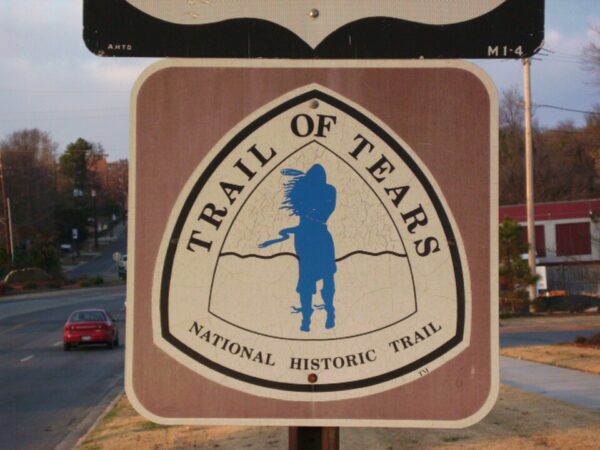
The most infamous removal came later in the decade. In 1838 and 1839, federal troops forced thousands of Cherokee people from their homes and marched them west to what is now Oklahoma. The journey became known as the Trail of Tears. Roughly one-quarter of the Cherokee population died from disease, starvation, and exposure.
The Indian Removal Act revealed the contradiction at the center of Jacksonian democracy. The same political movement that celebrated the rights of ordinary white men denied Native Americans their sovereignty, property, and basic human rights. It expanded democracy for some by destroying the freedom of others.

The act also marked a turning point in federal Indian policy. It showed that treaties could be used not as agreements between equal nations but as instruments of coercion. It showed that court victories meant little without executive enforcement. And it showed that the federal government was willing to use its power to clear Native people from valuable land when expansion demanded it.
For Native nations, removal was a violent rupture of communities, economies, sacred places, burial grounds, and political independence. Families were uprooted from farms, towns, and homelands that carried deep cultural and spiritual meaning.